50-year mystery solved: Astronomers finally detect wind from Milky Way’s giant black hole
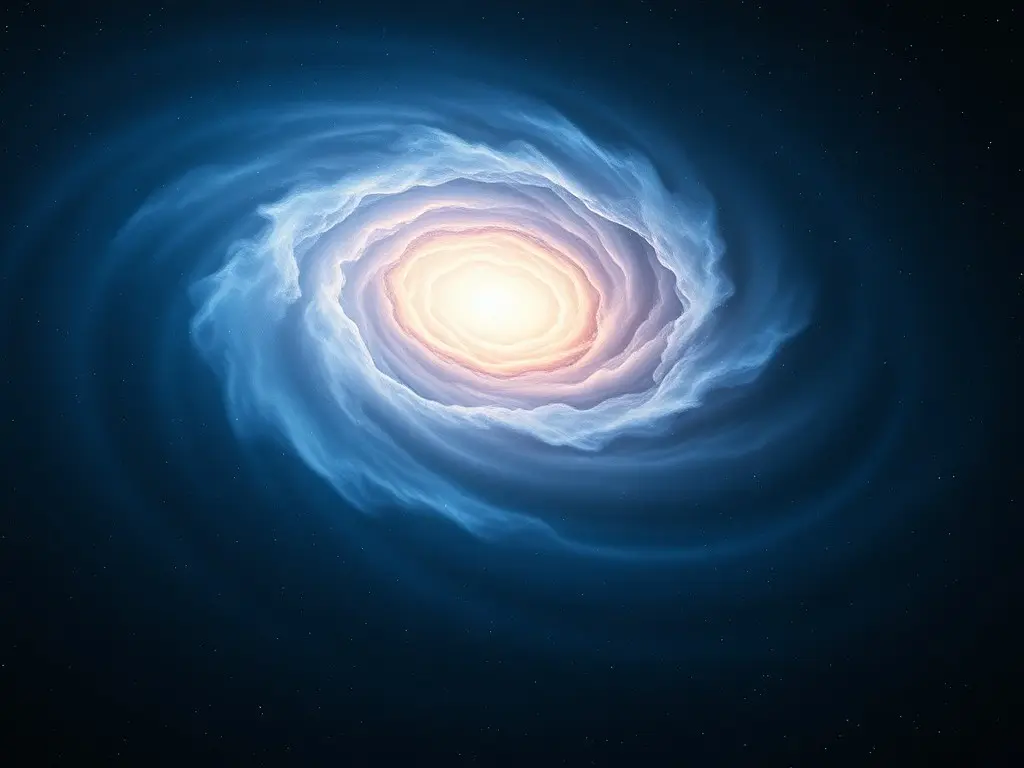
Astronomers using ALMA and NASA’s Chandra detected a 20,000-year-old wind from Sagittarius A*, the Milky Way’s supermassive black hole, solving a 50-year mystery. The conical cavity of hot gas near the black hole confirms the wind’s existence, aligning Sag A* with distant galaxy black hole behaviors.
Astronomers have resolved a decades-long mystery by detecting wind emanating from Sagittarius A*, the Milky Way’s supermassive black hole. Using five years of data from the Atacama Large Millimeter Array (ALMA) in Chile and NASA’s Chandra X-ray Observatory, researchers identified a 20,000-year-old outflow of gas near the black hole, which sits 26,000 light-years from Earth and contains four million times the Sun’s mass. The study, co-led by astrophysicists Mark Gorski and Elena Murchikova, found a large, cone-shaped cavity filled with hot, electrically charged gas. This cavity was created by powerful winds blowing outward from the black hole, though the wind itself moves at a gentle pace. Despite its mild speed, it effectively heats or displaces the colder gas in the region, demonstrating the black hole’s immense energy output. Published in *Astrophysical Journal Letters*, the findings confirm long-standing theories about black hole behavior. Murchikova, a professor at Northwestern University in Illinois, noted that while some gas falls into Sagittarius A*, more is ejected as wind—a phenomenon previously observed only in distant galaxies. The discovery bridges a gap between our galaxy’s black hole and those in far-off systems, where violent winds and jets are more visible. The study highlights how Sagittarius A* interacts with its surroundings, ejecting gas that could influence star formation in the Milky Way. Researchers now aim to further investigate how this wind affects the galaxy’s evolution, offering new insights into black hole dynamics and cosmic feedback mechanisms.
This content was automatically generated and/or translated by AI. It may contain inaccuracies. Please refer to the original sources for verification.