AI and Robotics Reconstruct Ancient Pompeii Frescoes
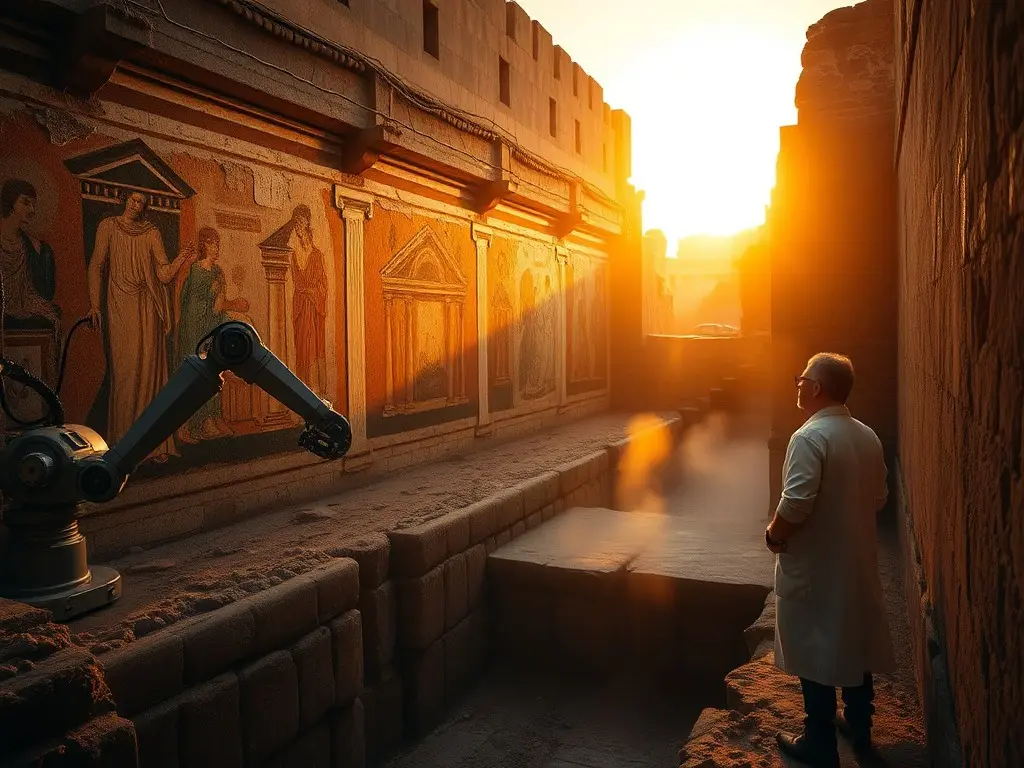
Researchers published findings from the RePAIR project, which used AI and robotics to reconstruct damaged frescoes in Pompeii’s House of Painters at Work, combining data analysis with expert-led restoration. The European Union-funded initiative, led by Ca’ Foscari University of Venice, demonstrates how advanced technologies can assist in preserving fragile cultural heritage while maintaining human oversight in interpretation and restoration decisions.
A new volume from the RePAIR project details how artificial intelligence and robotics can restore ancient frescoes in Pompeii. Funded by the European Union’s Horizon 2020 program, the initiative explored ways to combine these technologies with archaeology to address complex restoration challenges. Coordinated by Ca’ Foscari University of Venice, the project involved institutions from Europe and the Middle East, including Italy’s Institute of Technology, Israel’s Ben-Gurion University, Portugal’s Associação do Instituto Superior Técnico, and Germany’s Rheinische Friedrich-Wilhelms-Universität Bonn. The research focused on reconstructing thousands of fresco fragments from the House of Painters at Work, damaged first by Mount Vesuvius’ eruption in A.D. 79 and later by Allied bombings in 1943. An AI-powered robotic system analyzed shapes, colors, and patterns to match fragments, reducing manual handling of fragile materials. The project emphasized AI as a supportive tool rather than a replacement for archaeologists, who retain responsibility for interpretation and restoration. The published volume, edited by Marcello Pelillo, Alessandra Zambrano, and Gabriel Zuchtriegel, presents scientific findings and field experiments. Researchers demonstrated how AI processes large datasets quickly, enabling more efficient documentation and reconstruction of damaged artifacts. The technology could serve as a model for global heritage preservation efforts. The findings highlight the growing role of digital tools in protecting cultural heritage, offering a scalable approach for museums and archaeological teams. By integrating AI and robotics, the project reshapes how fragile historical objects are preserved for future generations.
This content was automatically generated and/or translated by AI. It may contain inaccuracies. Please refer to the original sources for verification.