AI powering a new era for the offshore wind industry
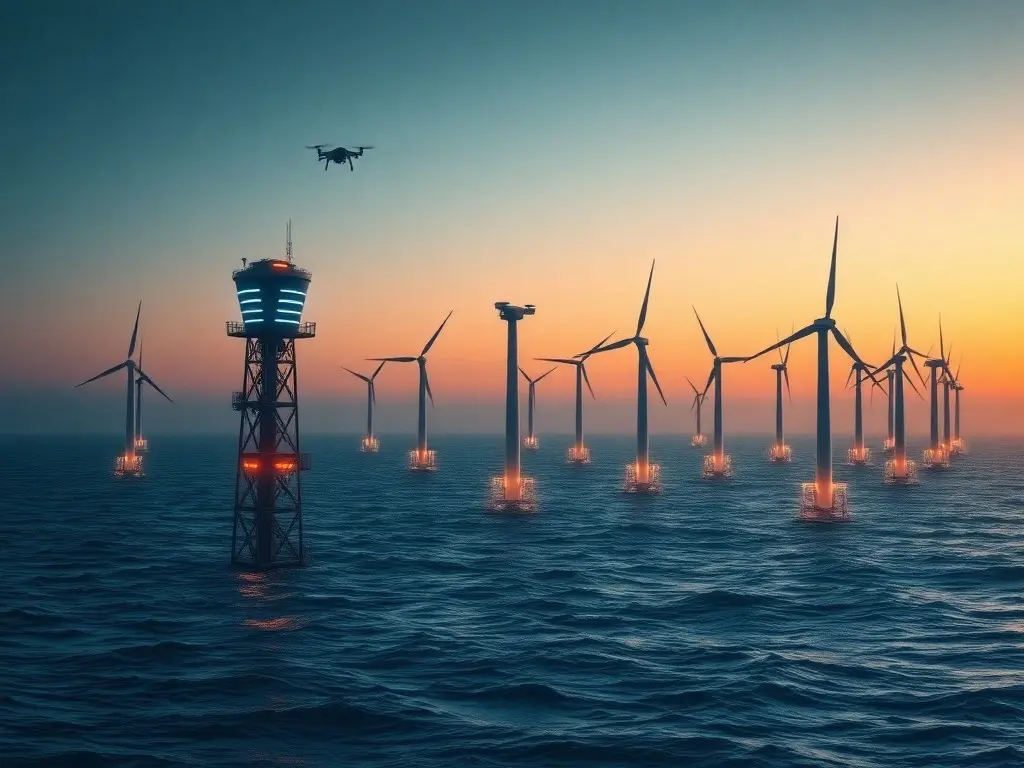
Artificial intelligence is transforming the UK offshore wind industry by enabling predictive maintenance, digital twin technology, and environmental monitoring to cut costs and improve efficiency. Companies like Entopy and AIM Group are collaborating with Ørsted after winning a digital innovation challenge to adapt AI solutions for offshore wind operations and maintenance.
Artificial intelligence is revolutionizing the UK’s offshore wind sector, shifting the industry toward data-driven efficiency and reduced maintenance costs. Operators now rely on AI to predict turbine failures before they occur, using sensor data like vibration and temperature to identify early warning signs. Digital twin technology—AI-powered virtual replicas of turbines—combines real-time data with physics-based modeling to simulate performance and prevent costly breakdowns. AI also optimizes wind farm logistics, forecasting energy output, adjusting turbine performance, and managing vessel availability to maximize efficiency. Environmental monitoring systems track marine mammals, seabed activity, and underwater noise, ensuring compliance and minimizing ecological impact. Advanced AI modeling even improves wind farm design, enhancing foundation layouts, turbine placement, and subsea cable infrastructure for better output and lower costs. Ørsted, a major offshore wind developer, has partnered with AI firms Entopy and AIM Group after they won the company’s Digital Innovation Challenge. The challenge, run with Digital Catapult and ORE Catapult, supports small businesses in adapting digital solutions for offshore wind operations. Ørsted has long used AI for predictive maintenance, logistics planning, and operational decision-making, with a focus on responsible, value-driven applications. The industry faces challenges similar to transport and logistics, such as asset coordination and resource planning, where AI provides resilience and visibility. By integrating AI across the wind farm lifecycle—from design to decommissioning—the sector aims to reduce lifecycle costs by up to 30% while improving reliability and sustainability. The shift underscores AI’s potential to reshape energy infrastructure globally.
This content was automatically generated and/or translated by AI. It may contain inaccuracies. Please refer to the original sources for verification.