Boston Dynamics Reveals How Atlas Learned to Lift 100-Pound Loads: Hyundai Plans 30,000 Per Year
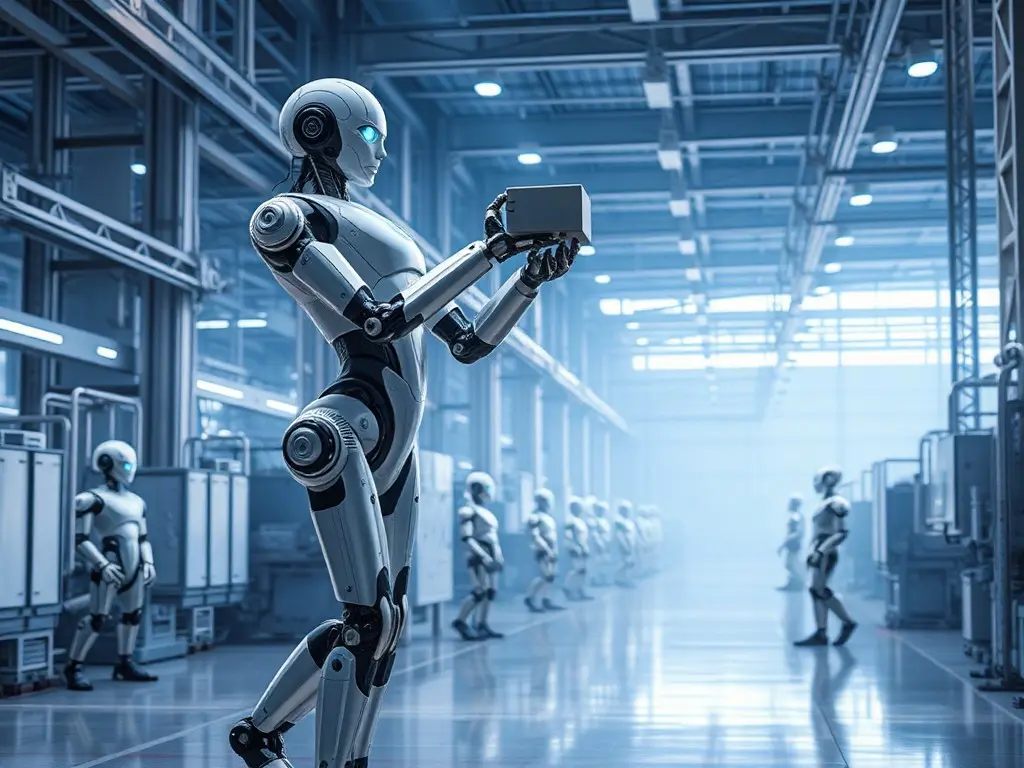
Boston Dynamics revealed on May 18 how its Atlas humanoid robot learned to lift over 100 pounds using internal body awareness and force feedback, compressing millions of simulated training hours into weeks. The company’s parent, Hyundai Motor Group, plans to deploy 30,000 Atlas units annually in automotive factories starting 2028, marking a shift from fixed-function industrial arms to adaptable humanoid labor tools.
Boston Dynamics published technical details and videos on May 18 explaining how its Atlas humanoid robot achieved heavy-lifting capabilities. The breakthrough involves teaching Atlas to rely on internal body position and force feedback—proprioception—rather than visual object recognition, allowing it to adapt to unfamiliar loads like a 100-plus-pound refrigerator without prior data. Engineers Alberto Rodriguez, Shane Rozen-Levy, and Vinay Kamidi led the work, which compresses millions of simulated training hours into real-world deployment within weeks. The robot’s unified control policy integrates walking, weight shifting, and balance adjustments, mimicking human instinct. Unlike traditional industrial arms, Atlas generalizes beyond training parameters—successfully lifting loads exceeding its 110-pound (50 kg) capacity in internal tests. This ‘zero-shot sim-to-real transfer’ eliminates the need for hardware-specific tuning, a major leap for robotic automation. Hyundai Motor Group, Boston Dynamics’ parent company, announced plans to mass-produce Atlas for automotive factories, targeting 30,000 units annually by 2028. The robot’s adaptability could reshape manufacturing, replacing rigid automation with versatile humanoid labor. The technical blog and videos highlight Atlas’s ability to handle dynamic tasks, such as rotating its torso 180 degrees mid-carry, by processing real-time joint data. Training begins with simulated animations, where Atlas practices lifts under varied conditions—weight, friction, grip—using GPU-parallel reinforcement learning. Disturbances are introduced to refine stability, and the policy generalizes to physical hardware without adjustments. The system’s efficiency was demonstrated weeks after Atlas’s January 2026 debut at CES, showcasing rapid real-world adaptation. Boston Dynamics emphasizes the practical implications for industries relying on manual labor, including manufacturing and logistics. Atlas’s capacity to learn and adapt in weeks challenges decades of fixed-function robotics, offering a scalable solution for unpredictable tasks. The company’s transparency about engineering teams and methods underscores its commitment to advancing humanoid robotics for industrial use.
This content was automatically generated and/or translated by AI. It may contain inaccuracies. Please refer to the original sources for verification.