Building computing power in space
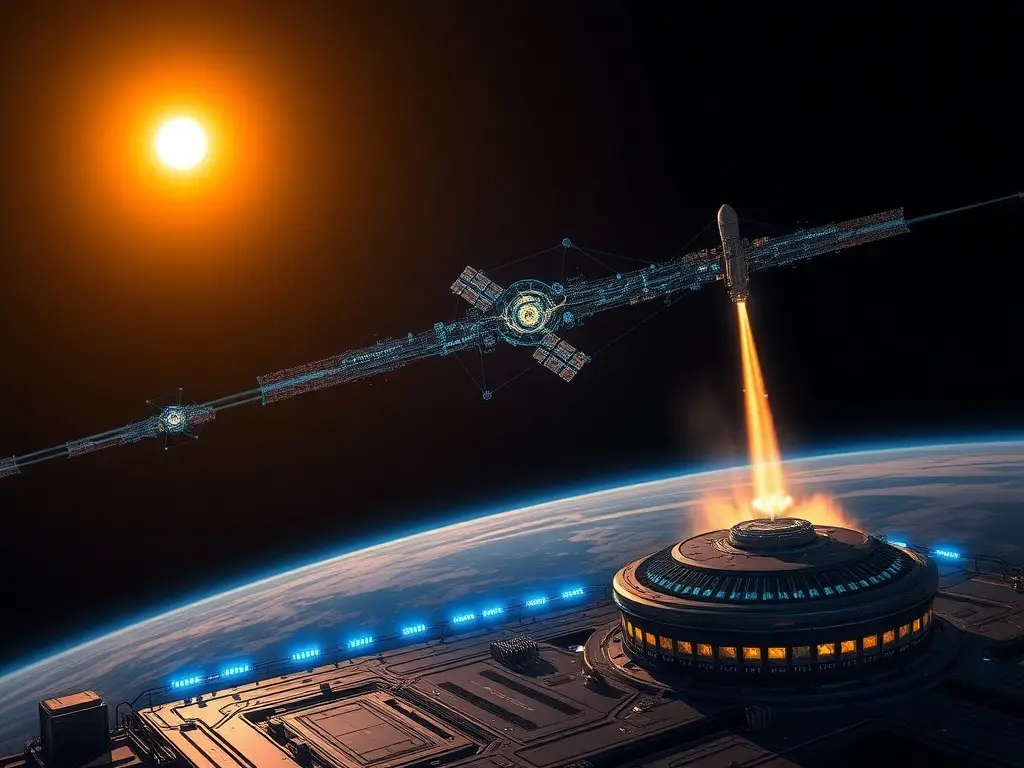
China launched the world's largest space-based computing constellation, the 'Three-Body Computing Constellation,' achieving 50 petaflops of in-orbit computing power to support AI models with up to 140 billion parameters. Industry analysts predict the global space computing market could exceed $1 trillion by 2035, driven by surging demand for computing power and advancements in reusable rocket technology.
China’s 'Three-Body Computing Constellation,' the world’s first space-based computing network, reached 50 petaflops of processing power after its May 2025 launch. Operating at an altitude of 500 kilometers, the constellation supports AI models with up to 140 billion parameters, enabling real-time data processing in orbit. The system reduces ground data center strain by transmitting only critical information back to Earth, improving efficiency and latency for applications like meteorological forecasting and fishery support. The 'FuXi' AI model, part of the constellation, now predicts 60-day weather patterns in three minutes using space-sourced meteorological data. Fishermen can query satellites via mobile apps, which use hyperspectral cameras to locate tuna schools and relay actionable insights. This 'space data, space computing' approach eliminates ground-based bottlenecks like energy consumption and heat dissipation, which surged 18.1% in China’s data centers in 2025. Analysts cite explosive AI growth and reusable rocket breakthroughs as key drivers for space computing. China’s data centers consumed 196 billion kilowatt-hours in 2025, with projections showing 20% annual growth through 2030. Space offers a 'green server room' with abundant solar energy and ultra-low temperatures, while avoiding fiber optic and base station limitations. Hangzhou-based STAR.VISION envisions orbital computing networks matching Earth’s internet accessibility. The company frames AI integration as essential to space industry evolution, positioning space-based infrastructure as future public utility. By 2035, the global space computing market could surpass $1 trillion, fueling demand for rockets, satellites, and space data centers. The shift reflects ground computing constraints, with space providing scalable, low-latency solutions. Xie Lina of the Cloud Computing & Big Data Research Institute noted reusable rockets and AI demand as critical enablers. Industry practitioners highlight space’s natural advantages, including reduced transmission costs and real-time data processing capabilities.
This content was automatically generated and/or translated by AI. It may contain inaccuracies. Please refer to the original sources for verification.