Cheryl Dunye builds space for Black queer cinema
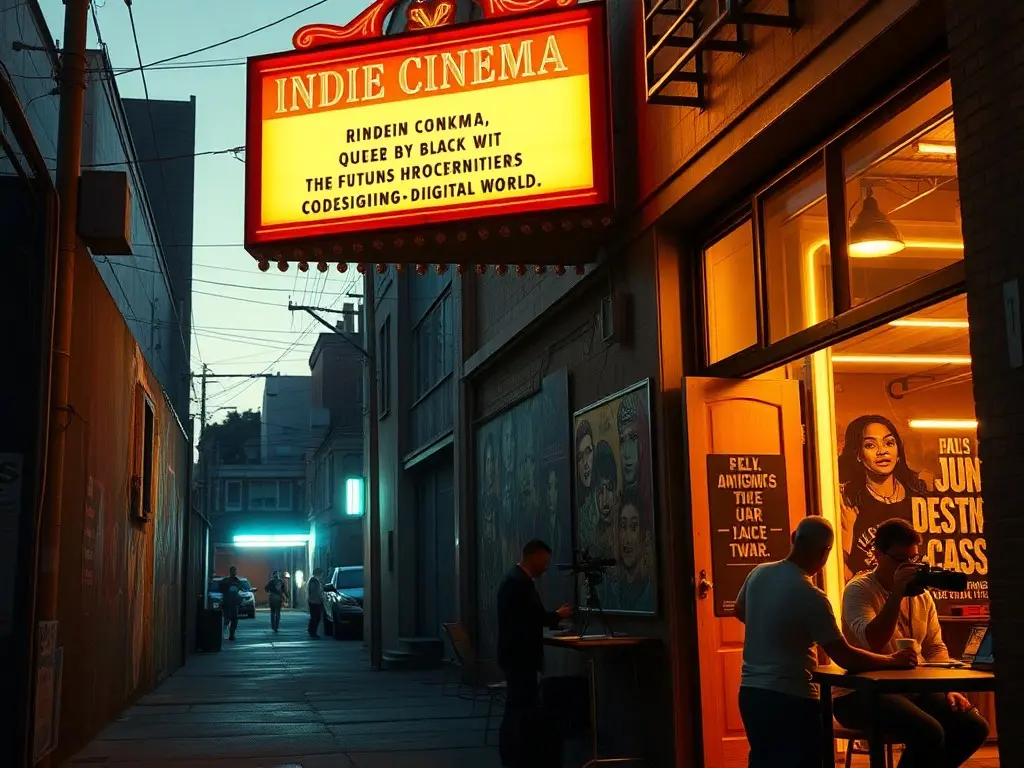
Cheryl Dunye, an Oakland-based Liberian-American filmmaker, has been named a 2026 Rainin Arts Fellowship recipient for her work in Black queer cinema, receiving a $100,000 grant to expand her production company, Jingletown Films. She plans to develop *Black is Blue*, a short film about trans AI professionals in Oakland, into a feature and use the fellowship to build infrastructure for underrepresented filmmakers in queer cinema.
Cheryl Dunye, an Oakland-based Liberian-American filmmaker, director, and producer, has been selected as one of the 2026 Rainin Arts Fellowship recipients by the Kenneth Rainin Foundation. The unrestricted $100,000 grant, awarded annually since 2021, recognizes artists whose work emphasizes community and pushes creative boundaries in the Bay Area. Dunye, born in Monrovia and raised in Philadelphia, will use the funds to develop *Black is Blue*, a 2014 short film about a Black trans man and woman working in AI tech in a near-future Oakland, into a feature-length project. Dunye’s career has centered on exploring race, gender, and sexuality in film, beginning with *Watermelon Woman*, her 1996 debut feature that won the Teddy Award at the Berlin International Film Festival. Her work has been exhibited globally, including at the Whitney Museum of American Art and festivals in San Francisco, New York, Melbourne, and Berlin. Beyond independent films, she has directed episodes for *Queen Sugar*, *Dear White People*, *Bridgerton*, *Lovecraft Country*, and *The Hunting Wives*. In 2018, Dunye founded Jingletown Films, a production company dedicated to serving underrepresented filmmakers while honoring Oakland’s cultural legacy. The company supports collaborative storytelling, often blending narrative and meta-commentary, as seen in *Watermelon Woman*, which intertwines a rom-com plot with critiques of Hollywood’s treatment of Black and queer women. *Black is Blue* similarly explores themes of power and representation in tech, questioning why trans stories in AI remain untold. The Rainin Fellowship marks a pivotal moment for Dunye, who describes it as validation for her broader vision: building a sustainable home for queer cinema. She emphasizes community over individual achievement, citing Audre Lorde’s philosophy that systemic change requires collective effort. ‘The master’s tools will never dismantle the master’s house,’ she notes, stressing that infrastructure—legal, financial, and creative—must be shared to uplift emerging filmmakers. Dunye’s priority is ensuring the next generation has access to the tools and support she lacked early in her career. The fellowship will fund the expansion of *Black is Blue* and reinforce Jingletown Films’ role as a hub for marginalized voices. ‘This sees the full picture,’ she says, highlighting the fellowship’s recognition of her dual role as filmmaker and producer fostering systemic change in cinema.
This content was automatically generated and/or translated by AI. It may contain inaccuracies. Please refer to the original sources for verification.