China is cutting 'obsolete' degrees for an AI future. Where does India stand?
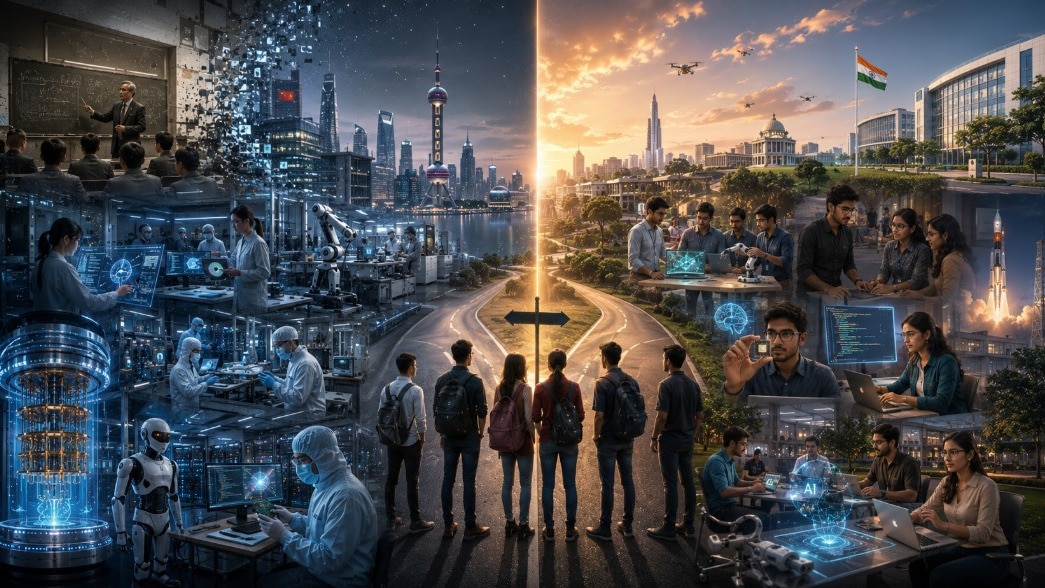
China has revoked or suspended over 12,200 undergraduate programs in arts, humanities, and management between 2021 and 2025 to prioritize AI, semiconductors, and robotics, while India continues producing millions of graduates in traditional disciplines like BA, BCom, and BSc, often for government job exams instead of tech-driven industries.
China is overhauling its higher education system to align with its AI and tech-driven economic strategy. Between 2021 and 2025, Chinese universities revoked or suspended over 12,200 undergraduate programs, primarily in arts, humanities, foreign languages, and management, while introducing about 10,200 new courses focused on AI, robotics, quantum computing, and semiconductors. The move aims to address youth unemployment by producing graduates for high-demand industries, though many still struggle to find jobs matching their qualifications. India’s education system faces a different but equally pressing challenge. Millions of students annually enroll in traditional BA, BCom, and BSc programs, often to meet eligibility requirements for government job exams rather than career readiness. While universities churn out graduates in humanities and social sciences, employers report critical shortages in AI, machine learning, cybersecurity, and data science roles. The disconnect highlights a growing mismatch between academic output and industry needs. China’s reforms reflect a deliberate economic strategy, treating universities as talent pipelines for strategic sectors. The government’s push to eliminate ‘obsolete’ degrees signals a shift toward skills directly tied to future industries, despite persistent unemployment in some fields. India, meanwhile, lacks a comparable overhaul, leaving its workforce ill-equipped for a rapidly evolving job market dominated by technology. Recent developments in Karnataka underscore the strain on India’s education system. The state government discontinued 458 BA, BSc, and BCom programs, though the broader national response remains fragmented. Without systemic changes, India risks graduating students for roles that no longer exist, deepening the skills gap in emerging sectors. The contrast between China’s aggressive restructuring and India’s reliance on traditional degrees raises questions about long-term preparedness. While China prioritizes AI and tech-driven fields, India’s system remains anchored in outdated qualifications, leaving its workforce vulnerable to automation and global competition.
This content was automatically generated and/or translated by AI. It may contain inaccuracies. Please refer to the original sources for verification.