China unveils humanoid robot for Moon mission
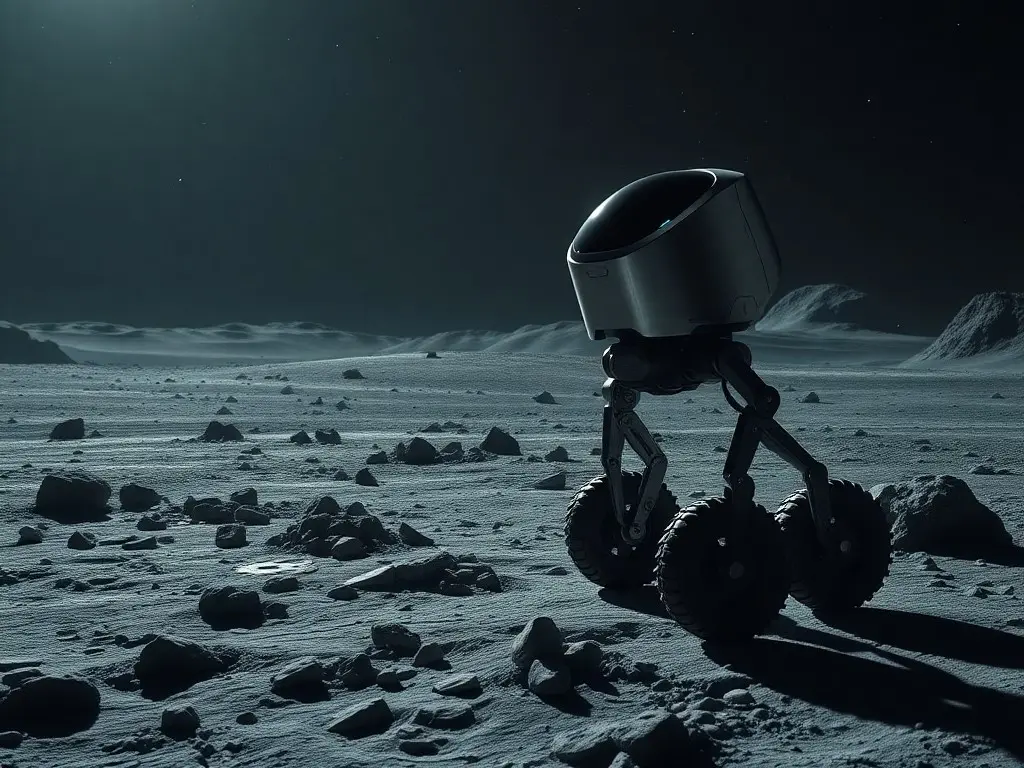
China’s Hong Kong University of Science and Technology (HKUST) unveiled a 100-kilogram AI-powered humanoid robot designed to support the 2029 Chang’e-8 Moon mission, acting as a porter for instrument installation ahead of a crewed landing. The robot, featuring a humanoid upper body and solar-powered wheels, will explore the Moon’s south pole, marking China’s first humanoid robotic demonstration on the lunar surface.
China has unveiled a 100-kilogram AI-powered humanoid robot developed by the Hong Kong University of Science and Technology (HKUST) for its 2029 Chang’e-8 Moon mission. The robot, equipped with a humanoid upper body and two arms mounted on a four-wheeled solar-panel module, will transport and install scientific instruments at various lunar locations in preparation for a crewed landing. HKUST professor Gao Yang stated the robot will operate autonomously using onboard AI to identify and trace objects, enabling strategic task execution. Unlike Chang’e-7’s planned south pole landing, this robot will explore a different region of the lunar south pole, offering novel insights into its terrain. China aims to send humans to the Moon by 2030, accelerating its ambitious space program over recent decades. Meanwhile, NASA’s Artemis IV mission targets a crewed lunar return by 2028, though delays in SpaceX’s Starship Human Landing System (HLS) development—including unresolved orbital refueling challenges—have raised concerns about meeting this timeline. A 2021 Senate Committee hearing warned that NASA’s complex architecture, requiring multiple launches and untested cryogenic refueling, could push the U.S. behind China in the lunar race. SpaceX’s Starship has completed only two test flights so far, with the next launch pending, further complicating NASA’s schedule. The HKUST robot’s mission underscores China’s growing capabilities in robotic lunar exploration, positioning it as a key player in future Moon missions.
This content was automatically generated and/or translated by AI. It may contain inaccuracies. Please refer to the original sources for verification.