Could the next AI data center be attached to your house?
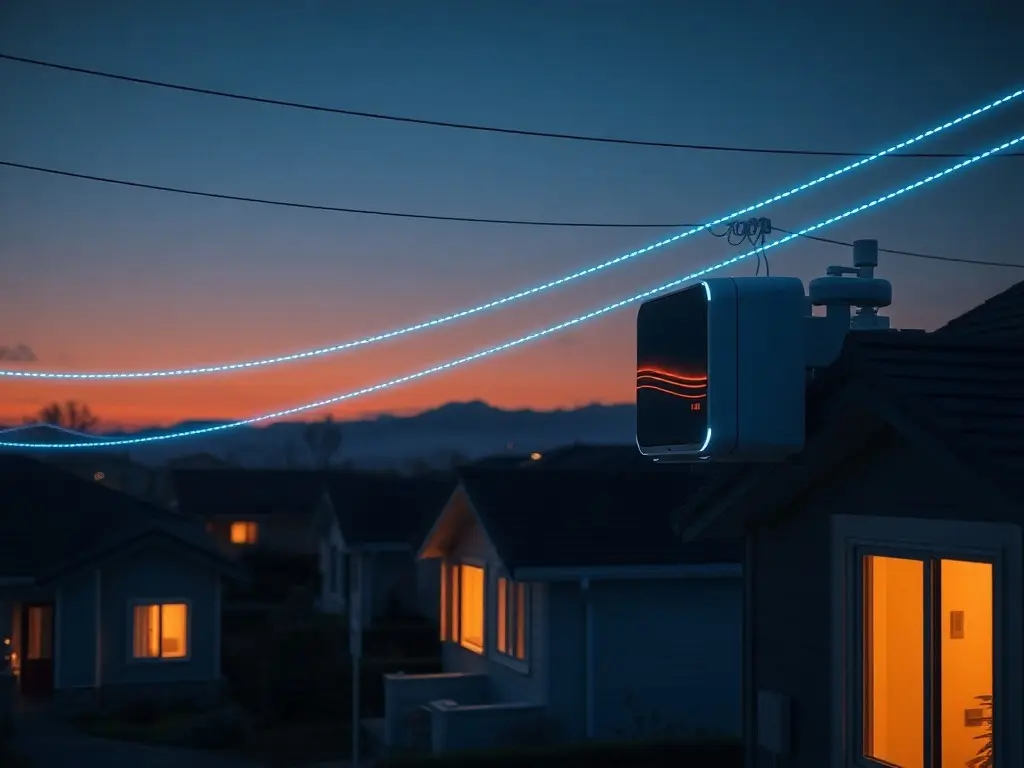
Span, a San Francisco-based smart-electrical-panel startup, unveiled XFRA, a distributed AI computing network using home-mounted nodes powered by Nvidia GPUs, aiming to bypass grid bottlenecks for data centers. Each XFRA unit, sized like an air conditioner, could draw unused residential power capacity while offering discounted electricity and internet to homeowners, though experts question its scalability against traditional data centers.
Span, a smart-electrical-panel startup based in San Francisco, has introduced XFRA, a distributed network of miniature AI computing units designed to attach to garage walls. Each unit, roughly the size of an air conditioner, contains 16 Nvidia GPUs, four CPUs, and three terabytes of RAM, capable of running large language models on a 16-GPU cluster. The system leverages unused residential power capacity—most homes are wired for 200 amps but use only about 80 at peak—to distribute AI computing tasks across thousands of homes already connected to the grid. The initiative addresses a growing bottleneck in the AI industry, where utilities struggle to connect power-hungry data centers to the grid quickly. Substation upgrades for a 100-megawatt data center can take four to seven years in the U.S., with over 2,060 gigawatts of generation and storage capacity waiting in interconnection queues as of late 2025, according to Lawrence Berkeley National Laboratory. XFRA aims to bypass this issue by spreading compute demand across homes, with roughly 8,000 nodes matching the power demand of a medium-sized 100-megawatt data center. Each XFRA node draws about 12.5 kilowatts at full power, equivalent to the energy an average U.S. household uses in a month over three days. Chris Lander, vice president of XFRA, notes that newer single-family homes often have unused electrical capacity—typically wired for 200 amps but using only around 80 at peak. By tapping into this excess, XFRA turns residential infrastructure into distributed computing power for AI cloud providers while potentially offering homeowners discounted electricity and internet in exchange. Experts remain skeptical about the approach’s scalability. Jonathan Koomey, a former Berkeley Lab researcher, questions whether the benefits outweigh the economies of scale of traditional purpose-built data centers. Rich Brown, another Berkeley Lab researcher, warns that distributed data centers could disrupt utility grid diversity, which helps balance peak and off-peak energy demands. Despite these concerns, Span’s technology presents a novel solution to the AI power crunch, though its long-term impact on residential grids and industry standards remains uncertain.
This content was automatically generated and/or translated by AI. It may contain inaccuracies. Please refer to the original sources for verification.