Giant Squid Detected off Western Australia in Stunning Deep-Sea Discovery
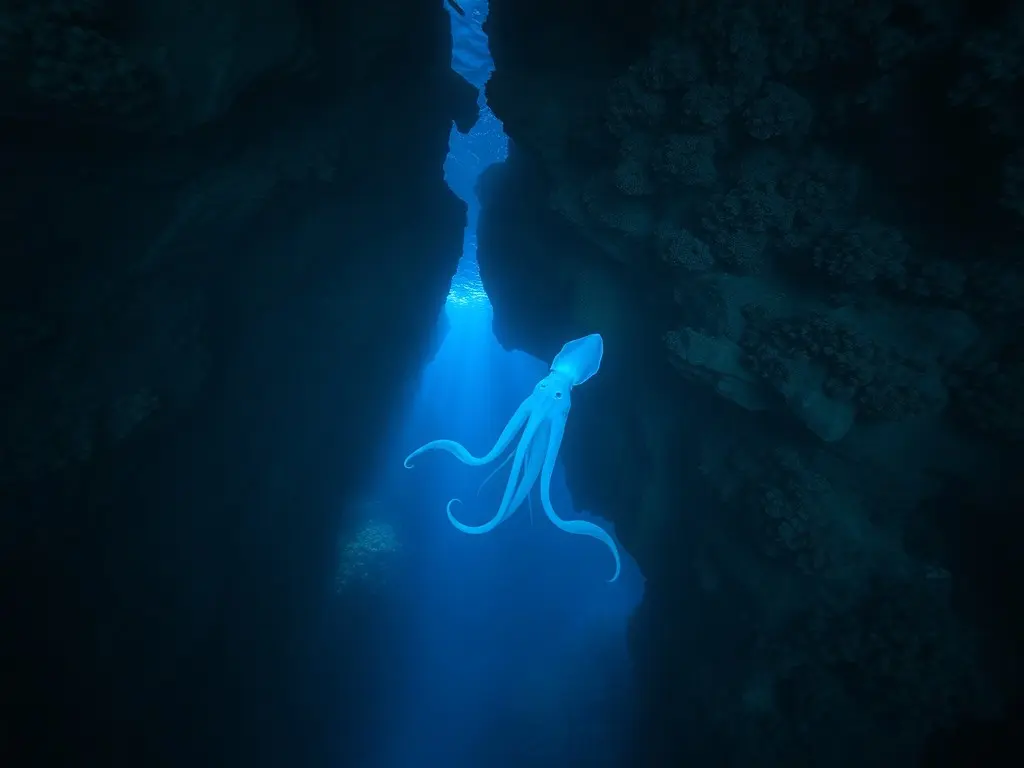
A Curtin University-led study detected giant squid and dozens of unknown species in deep underwater canyons off Western Australia’s Nyinggulu (Ningaloo) coast using environmental DNA. The expedition, conducted with the Western Australian Museum and Schmidt Ocean Institute, identified 226 species, including rare deep-sea creatures, highlighting vast undiscovered marine biodiversity in the region.
Scientists have uncovered a rich and previously unknown deep-sea ecosystem off Western Australia’s Nyinggulu (Ningaloo) coast using environmental DNA (eDNA). A study led by Curtin University, in collaboration with the Western Australian Museum and Schmidt Ocean Institute, detected genetic traces of species in submarine canyons near Cape Range and Cloates, about 1,200 kilometers north of Perth. Researchers collected over 1,000 seawater samples from depths reaching 4,510 meters, identifying 226 species across 11 animal groups, including rare deep-sea fish, squid, and marine mammals. One of the most significant findings was evidence of the giant squid (*Architeuthis dux*) in six separate samples, marking the first eDNA detection of the species in Western Australia. The discovery also included deep-diving whales such as the pygmy sperm whale (*Kogia breviceps*) and Cuvier’s beaked whale (*Ziphius cavirostris*). Additionally, dozens of species new to Western Australian waters were recorded, such as the sleeper shark (*Somniosus* sp.), faceless cusk eel (*Typhlonus nasus*), and slender snaggletooth (*Rhadinesthes decimus*). Dr. Georgia Nester, lead author and former Curtin University PhD student, emphasized the vast unknowns of deep-sea biodiversity. ‘Finding evidence of a giant squid captures people’s imagination, but it’s just one part of a much bigger picture,’ she said, noting that many detected species do not match existing records. Dr. Lisa Kirkendale, Head of Aquatic Zoology at the WA Museum, confirmed this was the first eDNA record of giant squid in the region and the northernmost detection of *A. dux* in the eastern Indian Ocean. The expedition used the Schmidt Ocean Institute’s R/V *Falkor* and a remotely operated vehicle, *SuBastian*, to collect samples and specimens. Researchers combined eDNA results with genetic references from physical specimens stored in the WA Museum’s Collection and Research Facility. This approach strengthened the identification of species, including those potentially new to science. The findings underscore the importance of deep-sea exploration and eDNA techniques in uncovering hidden marine life. Dr. Nester highlighted that the study reveals only a fraction of the biodiversity likely present in Australia’s deep waters, suggesting many more discoveries await future research.
This content was automatically generated and/or translated by AI. It may contain inaccuracies. Please refer to the original sources for verification.