Giant underground neutrino detector brings scientists closer to cracking the neutrino puzzle
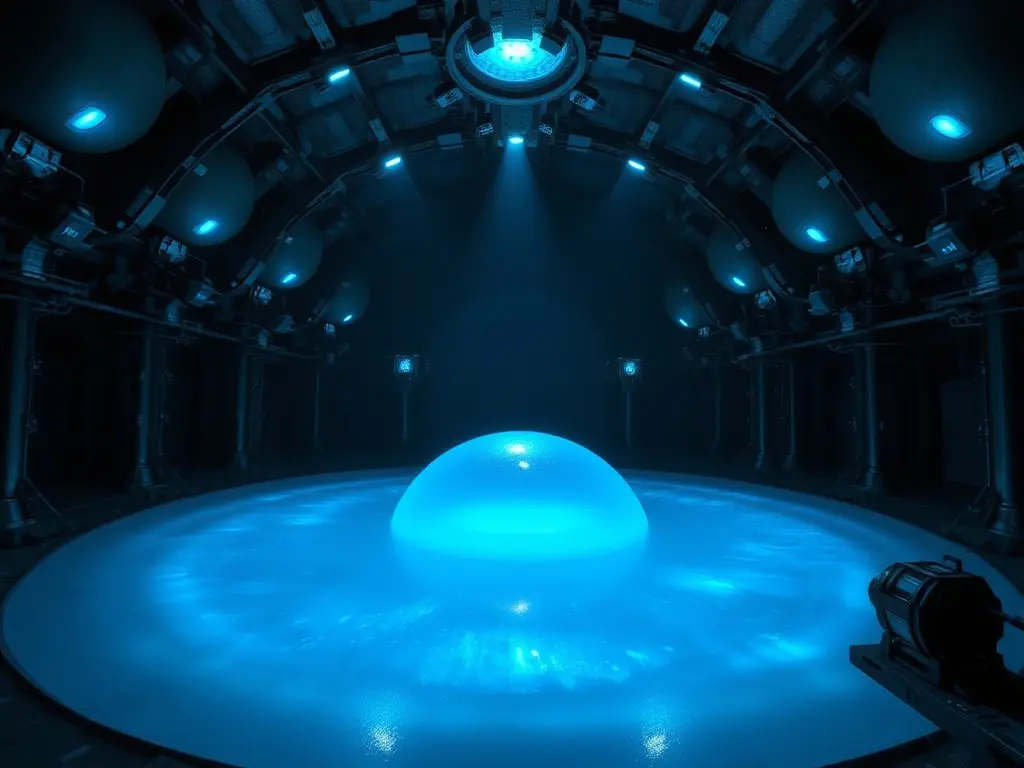
The Jiangmen Underground Neutrino Observatory (JUNO) in China published its first major physics result in *Nature* on June 10, 2026, achieving precise measurements of neutrino oscillation parameters using just 59 days of data. Researchers reduced uncertainties in key measurements by a factor of 1.6, advancing efforts to determine the neutrino mass hierarchy and positioning JUNO as a leader in particle physics.
The Jiangmen Underground Neutrino Observatory (JUNO) has reached a major milestone in particle physics, delivering its first key scientific findings. On June 10, 2026, *Nature* published the experiment’s debut physics result, showcasing highly precise measurements of neutrino oscillation parameters using 59 days of data collected between August 26 and November 2, 2025. Led by the Institute of High Energy Physics of the Chinese Academy of Sciences, the international JUNO Collaboration reduced uncertainties in these measurements by a factor of 1.6 compared to decades of prior research, bringing scientists closer to solving the neutrino mass hierarchy puzzle. Neutrinos, nearly massless and electrically neutral particles, interact weakly with matter, making them difficult to study. JUNO’s primary goal is to determine whether neutrinos follow a normal or inverted mass ordering, a question central to understanding fundamental physics. The observatory, located 700 meters underground, uses a 20,000-ton liquid scintillator detector housed in a 44-meter-deep water pool to capture rare neutrino interactions. The breakthrough was praised by peer reviewers, who highlighted JUNO’s detector performance and methodology. *Nature* noted that the results mark the beginning of a new era in neutrino research, with potential implications for the Standard Model of particle physics. Earlier this year, *Chinese Physics C* featured JUNO’s detector performance on its cover, reinforcing its readiness for ambitious physics goals. Nobel laureate Prof. Arthur McDonald commended JUNO’s achievements, stating that the experiment has met its design objectives in radiopurity, energy resolution, and stability. With its advanced capabilities, JUNO is now poised to study neutrinos from supernovae, the Sun, Earth’s interior, and other sources, while also exploring physics beyond the Standard Model. The success of JUNO’s first analysis builds confidence that the observatory will deliver definitive answers about neutrino properties, including their mass ordering. This milestone underscores China’s growing role in cutting-edge particle physics research and sets the stage for future discoveries in neutrino science.
This content was automatically generated and/or translated by AI. It may contain inaccuracies. Please refer to the original sources for verification.