Groundbreaking: ‘Controlled’ Quakes Triggered Under Swiss Alps
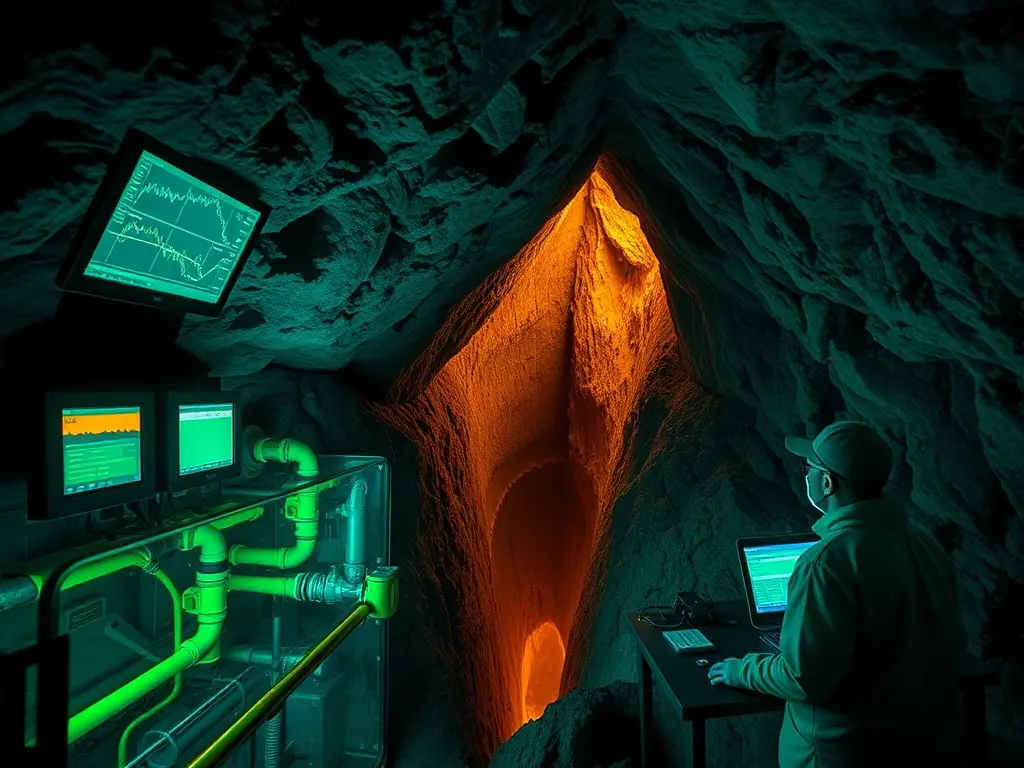
Researchers at ETH Zurich successfully triggered 8,000 tiny earthquakes in the BedrettoLab beneath the Swiss Alps by injecting water into a fault line, marking a breakthrough in understanding seismic activity at depth. The experiment, part of the FEAR-2 project, aimed for a magnitude-1 quake but achieved magnitudes between -5 and -0.14, with no surface impact and controlled safety measures in place.
Scientists at the Federal Institute of Technology in Zurich (ETH Zurich) conducted an experiment in late April to induce controlled earthquakes deep beneath the Swiss Alps. Using the BedrettoLab, a research facility inside a 5.2-kilometer tunnel near the Furka railway tunnel, researchers injected 750 cubic meters of water into boreholes drilled into the rock walls. The goal was to provoke a magnitude-1 earthquake along a pre-selected fault line, with all operations managed remotely from the ETH Zurich lab for safety. The experiment, called Fault Activation and Earthquake Rupture (FEAR-2), involved dozens of European scientists and successfully triggered 8,000 small seismic events. While the targeted magnitude was not fully reached, the results exceeded prior lab-scale efforts in both scale and depth. Domenico Giardini, a geology professor at ETH Zurich, described the project as a success, noting that the quakes ranged from magnitudes -5 to -0.14, with the largest producing an acceleration of 1.5 times gravity near the fault. The induced quakes remained confined underground, with no detectable tremors at the surface. Giardini emphasized that the experiment did not create new faults but instead facilitated movement along existing ones. The findings will help refine future attempts to reach a magnitude-1 quake during a follow-up test in June, with adjustments to water injection angles based on current data. The BedrettoLab’s location, with 1.5 kilometers of mountain above it, provided an ideal setting to observe fault behavior closely. Researchers equipped the fault with sensors and instruments to monitor seismic activity in real time. A temporary power outage briefly disrupted the experiment, but operations resumed quickly, demonstrating the resilience of the setup. The project pushes scientific boundaries by allowing researchers to study earthquake mechanics in controlled conditions. Ryan Schultz, a seismologist specializing in induced earthquakes, called it a frontier-expanding endeavor. The insights gained could improve understanding of seismic risks and potentially reduce hazards associated with natural earthquakes.
This content was automatically generated and/or translated by AI. It may contain inaccuracies. Please refer to the original sources for verification.