Hidden Solar Storms May Be Lighting Japan’s Skies With Massive Red Auroras
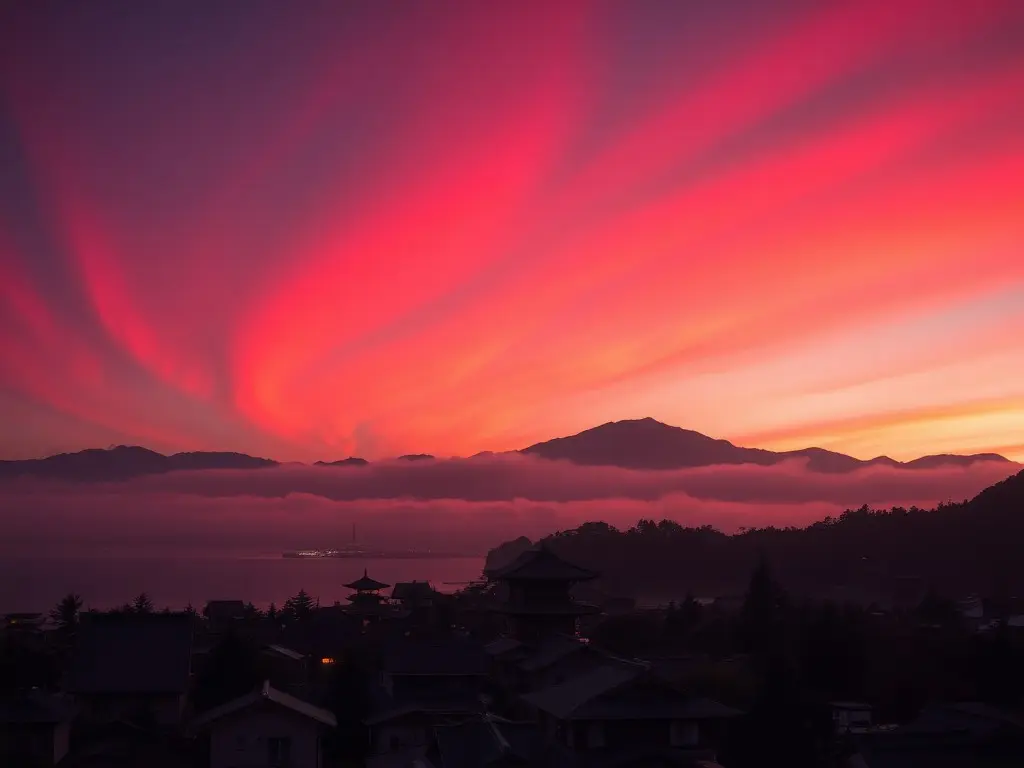
Researchers from Hokkaido University and the Okinawa Institute of Science and Technology discovered unusually high-altitude red auroras over Japan, extending up to 800 kilometers, suggesting some solar storms may be stronger than previously measured. The study, published in *Journal of Space Weather and Space Climate*, indicates these storms could pose greater risks to satellites due to increased atmospheric drag from upper atmospheric heating.
A study published in the *Journal of Space Weather and Space Climate* reveals that red auroras observed over Japan between June 2024 and March 2025 reached altitudes of 500-800 kilometers, far higher than typical low-latitude auroras. Researchers from Hokkaido University and the Okinawa Institute of Science and Technology analyzed five auroral events, finding that incoming solar particles compressed Earth’s magnetosphere more intensely than standard measurements indicated. The team, led by Tomohiro M. Nakayama, suggests dense solar wind streams may have masked the storms’ true intensity by heating the upper atmosphere and pushing auroras to unprecedented heights. Standard indices classified these storms as moderate, but the findings imply they could be far more powerful than recorded. Citizen scientists across Japan contributed photographs, allowing the researchers to reconstruct the auroras’ elevation and position using multiple observation points. This collaboration provided critical data, as traditional networks alone would have missed the rare high-altitude events. The discovery has implications for satellite operations, as expanded upper atmospheric heating increases drag on low Earth orbit spacecraft. Nakayama noted that improved space weather forecasting could mitigate risks as satellite numbers grow. The study, titled *Faint red auroras as seen from Japan associated with intense magnetospheric compression*, was published on May 19, 2026.
This content was automatically generated and/or translated by AI. It may contain inaccuracies. Please refer to the original sources for verification.