Ho Chi Minh City maps out 100-year vision to become leading Asia-Pacific hub
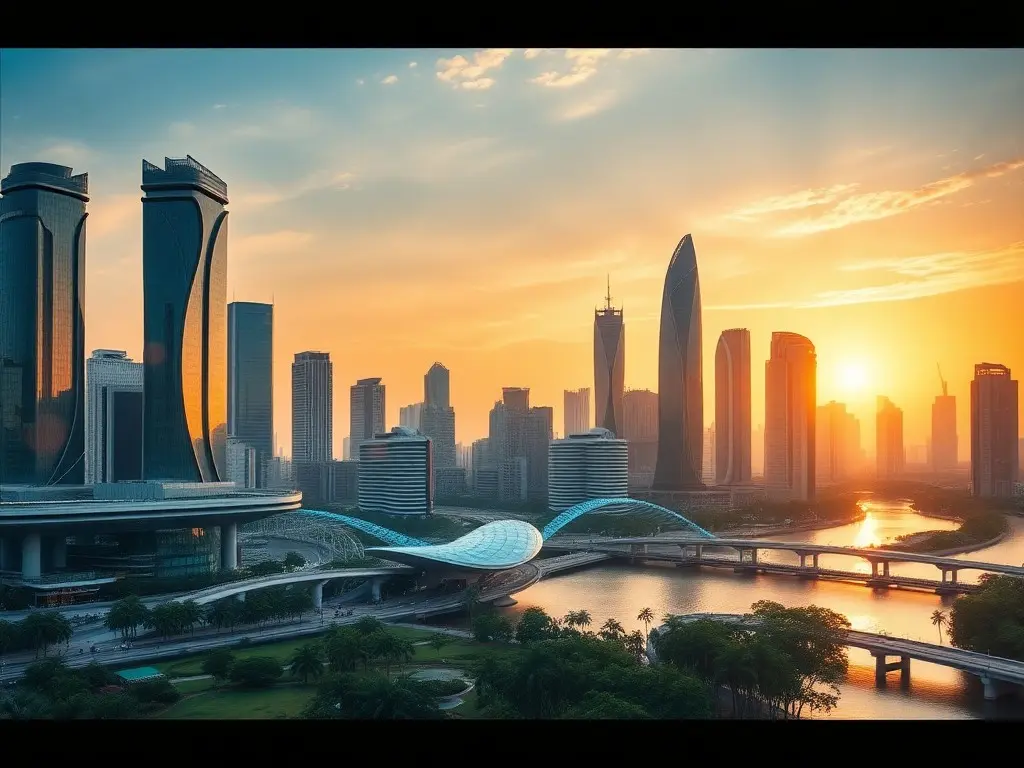
Ho Chi Minh City launched a 100-year master plan to solidify its position as a leading Asia-Pacific economic and innovation hub, addressing challenges like climate change, land subsidence, and regional competition. The city, now Vietnam’s largest with over 14 million residents, aims for a $1.2 trillion economy by 2050 and top-100 global city status by mid-century, focusing on high-tech, finance, logistics, and education.
Ho Chi Minh City (HCM City) has unveiled a 100-year master plan to position itself as a dominant economic, financial, and innovation hub in the Asia-Pacific region. The initiative follows the city’s recent expansion into a 6,700 sq km super-city with over 14 million residents, making it Vietnam’s largest growth engine and a key investment destination in Southeast Asia. The plan aligns with Politburo Resolution No. 09, which calls for a long-term strategy to unlock HCM City’s potential amid demographic, economic, and climate challenges. Vo Van Minh, chairman of the city People’s Council, highlighted the city’s contributions—over 23% of Vietnam’s GDP, 30% of state budget revenue, and 20.7% of import-export turnover—while warning of unprecedented pressures on infrastructure, housing, and environmental management. Experts emphasize the need for a century-long vision to address issues like climate change, land subsidence, and competition from other global cities. Dr Pham Viet Thuan, director of the HCM City Institute of Economics, Resources and Environment, stressed that conventional 20-30-year planning frameworks are insufficient for a city projected to reach 20-22 million people by 2050 and a $1.2 trillion economy. The draft framework outlines five strategic growth pillars: high-tech industry, logistics, an international financial center, tourism, and education/healthcare/science. Development will focus on four key zones: a financial core, an innovation hub in Thu Duc, advanced manufacturing in the north, and a marine economy cluster in the southeast. The plan also prioritizes smart governance, climate-resilient infrastructure, and a multi-center urban model to sustain growth. HCM City aims to rank among the world’s top 100 cities for quality of life by 2050, targeting 10% annual GRDP growth between 2025 and 2050. The initiative follows Hanoi’s adoption of a similar 100-year plan, marking Vietnam’s dual approach to long-term urban challenges.
This content was automatically generated and/or translated by AI. It may contain inaccuracies. Please refer to the original sources for verification.