How Indians Are Training AI Robots To Take On Household Jobs In The Future
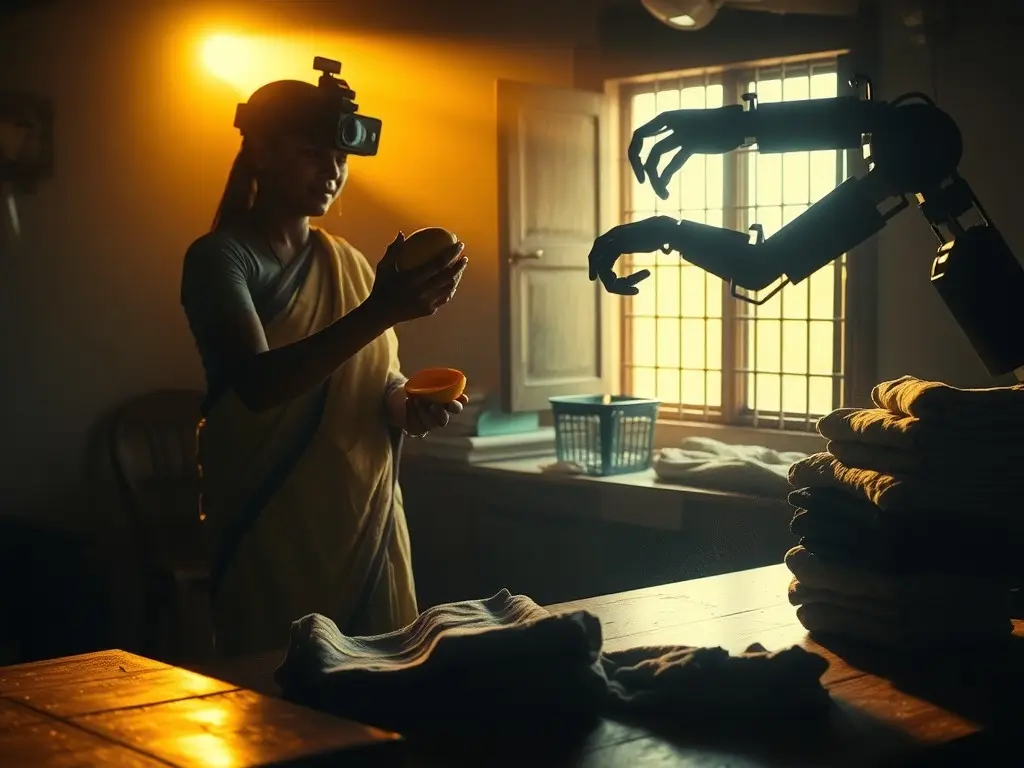
Indian workers, including housewives and factory employees, are training AI robots by filming household tasks like slicing mangoes or folding clothes using head-mounted cameras, earning minimal wages for data collection. Objectways, a US-India firm, uses this 'egocentric data' to teach robots human-like movements, catering to global tech clients while raising concerns about job displacement for informal workers.
Indian workers are training AI-powered robots by recording mundane household tasks, such as Nagireddy Sriramyachandra, a 25-year-old housewife from Chennai, who films herself slicing mangoes for two dollars an hour. These recordings, called 'egocentric data,' help developers teach robots to mimic human movements in real-world environments, a challenge distinct from training AI chatbots or image generators. Objectways, a company with offices in India and the United States, employs thousands of workers to collect this data, supplying Fortune 500 clients like Amazon SageMaker. Workers use head-mounted cameras, video glasses, or motion sensors, either at home or in studios, to capture tasks like folding clothes, making coffee, or cooking specific dishes. Objectways CEO Ravi Shankar predicts robots will eventually handle such jobs, freeing humans for 'better things.' In Tamil Nadu, one of India’s tech hubs, workers at a Karur textile factory wear smart glasses to record tasks for AI training. India has positioned itself as a global leader in AI data processing, with experts like Aditi Surie of the Indian Institute for Human Settlements warning that demand for such services will likely rise. However, India’s push into AI raises concerns about job displacement, particularly for the 490 million informal workers who form the backbone of the economy. A report by government think-tank NITI Aayog highlights that AI discussions often overlook these workers, who include cobblers, farmers, and street vendors. Ponni, a 55-year-old flower garland maker in Bengaluru, fears automation could threaten future generations in her profession. At Objectways’ studios, workers like 21-year-old engineering graduate Rani N. film tasks in simulated apartments, with environments adjusted to provide varied training data. The company’s work reflects India’s growing role in AI development, though critics emphasize the need for policies to mitigate automation’s impact on vulnerable labor sectors.
This content was automatically generated and/or translated by AI. It may contain inaccuracies. Please refer to the original sources for verification.