Humanoid Robots Reach Production Scale: Robotics Summit Opens on ROS vs. Proprietary Physical AI
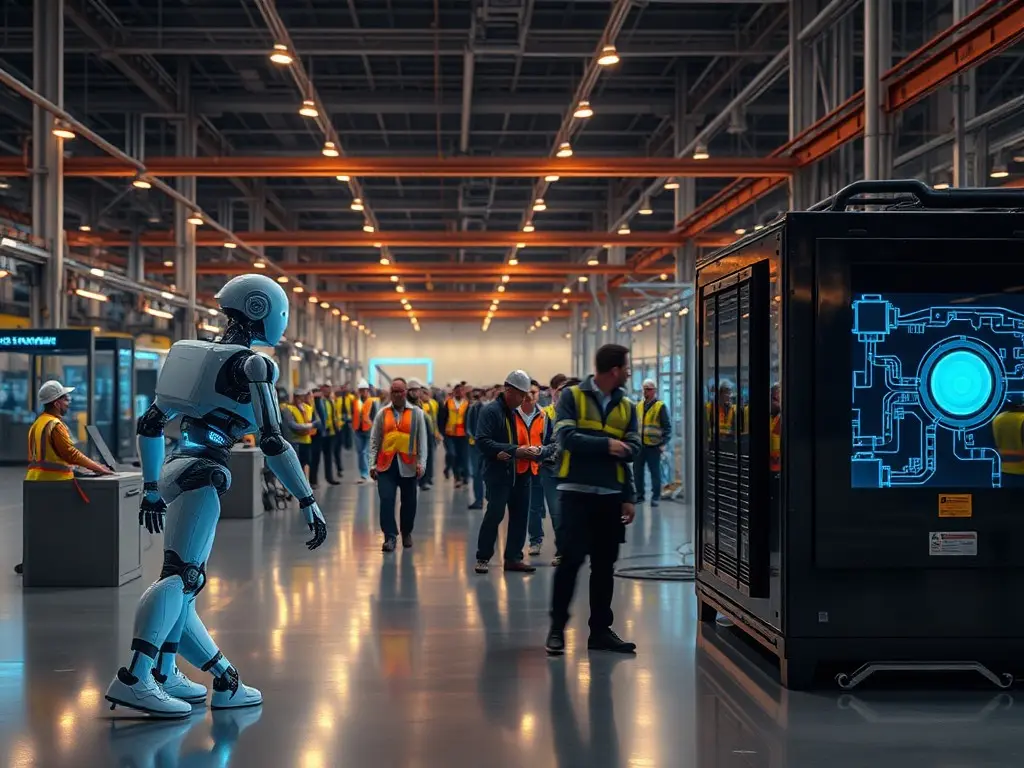
The 2026 Robotics Summit & Expo in Boston will debate whether open-source software like ROS or proprietary platforms will dominate the booming humanoid robotics industry, as companies like Figure AI, Agility Robotics, and Boston Dynamics deploy robots in real-world production. Open Robotics’ Brian Gerkey will advocate for open-source systems, while NVIDIA, Google DeepMind, and others push competing proprietary AI-driven robotics ecosystems." "article": "The 2026 Robotics Summit & Expo opened Wednesday at the Thomas M. Menino Convention and Exhibition Center, focusing on a critical question for the industry: whether open-source software or proprietary platforms will control the future of humanoid robotics. The shift from theoretical development to real-world deployment has accelerated in the past 18 months, with Figure AI’s Figure 02 robot operating at BMW’s Spartanburg, South Carolina plant for 11 months, handling over 90,000 sheet-metal components in 1,250 hours. Agility Robotics’ Digit has also entered commercial use at a GXO Logistics facility in Flowery Branch, Georgia, moving over 100,000 totes under a Robots-as-a-Service model, marking the first formal commercial humanoid deployment. Open Robotics, the organization behind the Robot Operating System (ROS), will lead the debate with a keynote by Brian Gerkey, its co-founder and CTO of Google’s robotics subsidiary Intrinsic. Gerkey will argue that ROS is essential for collaborative, trustworthy AI-driven robotics development, positioning it as the foundation for the industry’s growth. His stance contrasts with proprietary alternatives, including NVIDIA’s full-stack physical AI ecosystem announced at CES 2026, which aims to become the default platform for general-purpose robots, similar to how Android dominates smartphones. The competition extends beyond NVIDIA, with Google DeepMind’s Gemini Robotics platform, Physical Intelligence’s π0 model, and Covariant’s robot learning frameworks all advancing proprietary stacks. The debate centers on whether ROS can integrate vision-language-action (VLA) models, which combine perception, natural language understanding, and physical control into a single system. Unlike earlier robot software requiring separate models for each task, VLA models enable robots to interpret instructions and adapt to new environments without retraining. ROS currently powers millions of deployed robots and remains the default for most commercial development, but its ability to absorb VLA advancements will determine its long-term relevance. The summit highlights the industry’s transition from ‘if’ to ‘how’—with companies like Boston Dynamics’ Atlas already in commercial production, committed to Hyundai and Google DeepMind. The outcome of this debate will shape the robotics industry’s infrastructure for years to come.
The 2026 Robotics Summit & Expo opened Wednesday at the Thomas M. Menino Convention and Exhibition Center, focusing on a critical question for the industry: whether open-source software or proprietary platforms will control the future of humanoid robotics. The shift from theoretical development to real-world deployment has accelerated in the past 18 months, with Figure AI’s Figure 02 robot operating at BMW’s Spartanburg, South Carolina plant for 11 months, handling over 90,000 sheet-metal components in 1,250 hours. Agility Robotics’ Digit has also entered commercial use at a GXO Logistics facility in Flowery Branch, Georgia, moving over 100,000 totes under a Robots-as-a-Service model, marking the first formal commercial humanoid deployment. Open Robotics, the organization behind the Robot Operating System (ROS), will lead the debate with a keynote by Brian Gerkey, its co-founder and CTO of Google’s robotics subsidiary Intrinsic. Gerkey will argue that ROS is essential for collaborative, trustworthy AI-driven robotics development, positioning it as the foundation for the industry’s growth. His stance contrasts with proprietary alternatives, including NVIDIA’s full-stack physical AI ecosystem announced at CES 2026, which aims to become the default platform for general-purpose robots, similar to how Android dominates smartphones. The competition extends beyond NVIDIA, with Google DeepMind’s Gemini Robotics platform, Physical Intelligence’s π0 model, and Covariant’s robot learning frameworks all advancing proprietary stacks. The debate centers on whether ROS can integrate vision-language-action (VLA) models, which combine perception, natural language understanding, and physical control into a single system. Unlike earlier robot software requiring separate models for each task, VLA models enable robots to interpret instructions and adapt to new environments without retraining. ROS currently powers millions of deployed robots and remains the default for most commercial development, but its ability to absorb VLA advancements will determine its long-term relevance. The summit highlights the industry’s transition from ‘if’ to ‘how’—with companies like Boston Dynamics’ Atlas already in commercial production, committed to Hyundai and Google DeepMind. The outcome of this debate will shape the robotics industry’s infrastructure for years to come.
This content was automatically generated and/or translated by AI. It may contain inaccuracies. Please refer to the original sources for verification.