Inside China’s Push to Build a Shared ‘Super Brain’ for Humanoid Robots
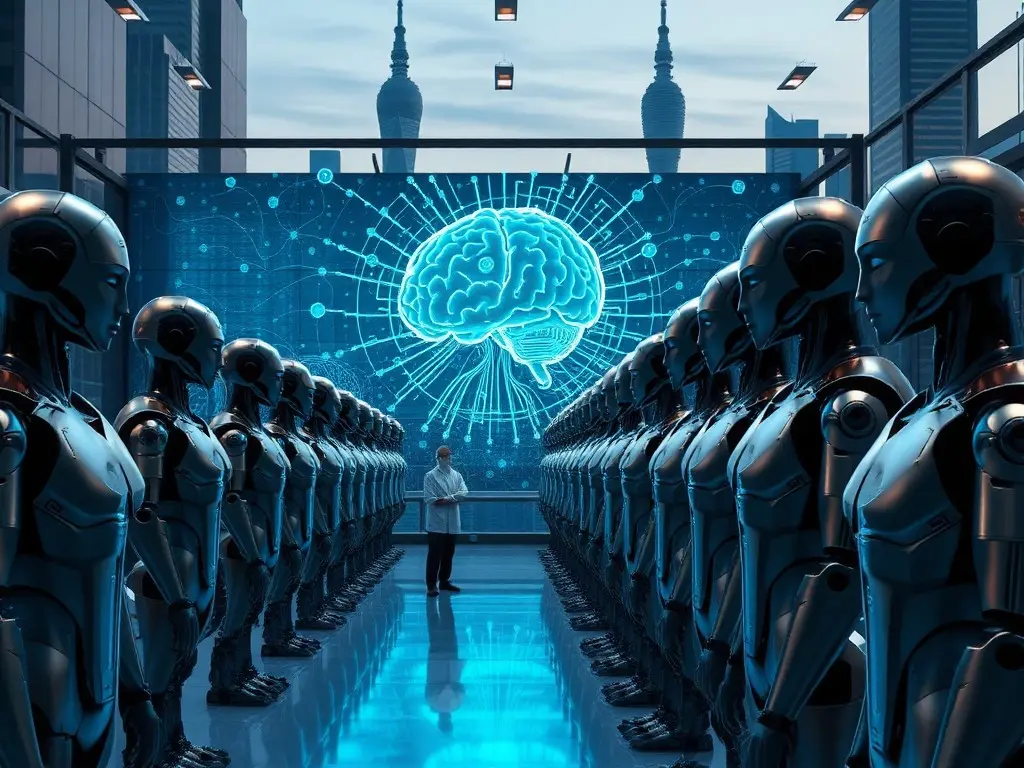
China is establishing specialized training centers, including a 5,000-square-meter facility in Shanghai’s Zhangjiang tech hub, to teach over 100 humanoid robots from different companies 45 core skills through repetitive, structured tasks like folding clothes and organizing shelves. The goal is to create a unified ‘super brain’ for robots by consolidating data into a shared intelligence system, enabling large-scale production of up to 100,000 humanoid robots annually for industries like manufacturing, healthcare, and logistics.
China is rapidly expanding its humanoid robotics capabilities by establishing dedicated training centers to prepare robots for real-world tasks. In Shanghai’s Zhangjiang tech hub, a 5,000-square-meter facility houses over 100 robots from various companies, where they undergo intensive training in 45 core skills, including folding clothes, organizing shelves, and handling objects with precision. These robots repeat tasks hundreds or even thousands of times daily to refine motion control and decision-making, with trainers using motion-capture gear or VR headsets to guide their movements. The training process relies on brute repetition, as robots struggle with unpredictable tasks like handling fabric, which lacks a fixed structure. Engineers compensate by running the same motions across multiple machines to ensure reliability. Beyond individual training, China aims to develop a centralized ‘super brain’—a shared intelligence system that consolidates learning across different robot models and manufacturers. This would allow new robots to inherit skills immediately, reducing the need for redundant training. The initiative aligns with China’s industrial strategy, with expectations of producing up to 100,000 humanoid robots annually for applications in manufacturing, healthcare, agriculture, and logistics. Currently, robots are deployed in diverse environments, including domestic spaces and industrial settings, to prepare them for broader real-world use. If successful, this approach could transform humanoid robot development from isolated lab work into scalable industrial infrastructure. However, challenges remain, particularly in handling the unpredictable nature of human environments. While robots excel at structured tasks, their ability to adapt to messy or unscripted scenarios is still under development. The long-term vision hinges on whether China can bridge this gap and create robots capable of seamless integration into everyday human spaces.
This content was automatically generated and/or translated by AI. It may contain inaccuracies. Please refer to the original sources for verification.