Invisible Highways: Every honey bee has its own GPS-like route and follows it with unbelievable precision
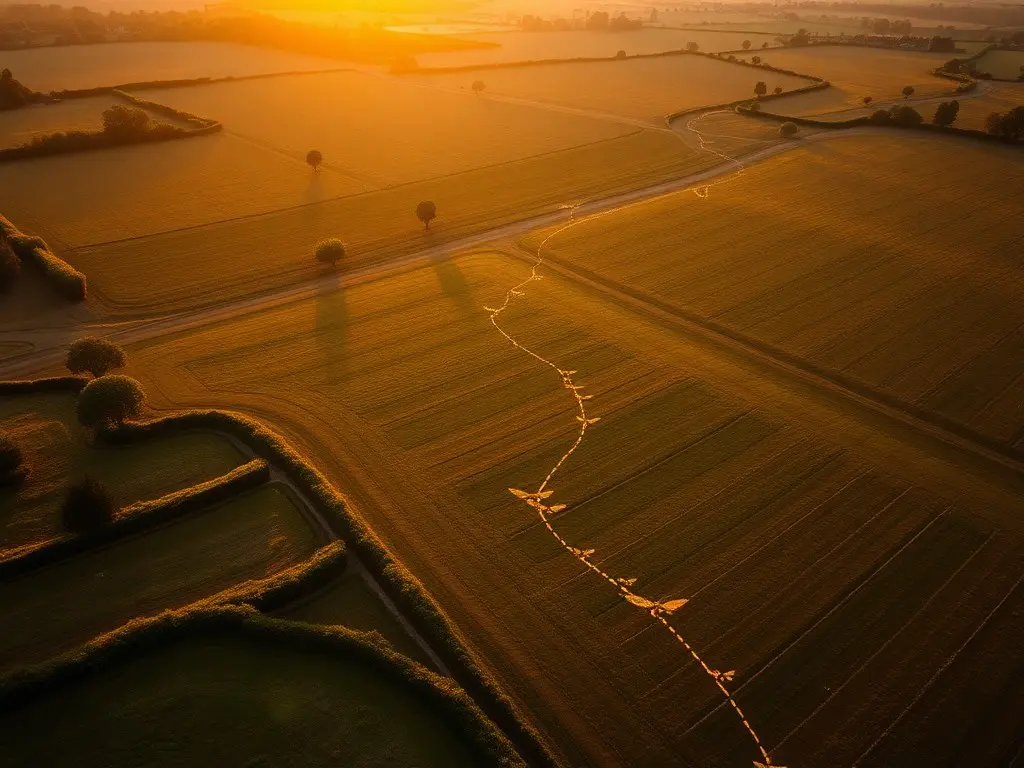
Researchers from the University of Freiburg used drone-based tracking to discover that honey bees follow highly precise, individualized flight routes with centimeter-level accuracy, relying on landmarks like trees and hedges. The study, published in an agricultural landscape near Kaiserstuhl, challenges previous assumptions about insect navigation by revealing that bees maintain consistent personal paths rather than generic routes.
A team led by neurobiologist Professor Andrew Straw at the University of Freiburg developed a drone-based tracking system called Fast Lock-On (FLO) Tracking to study honey bee navigation in real-world conditions. The system attached tiny reflective markers to bees and recorded their 3D flight paths with millisecond precision over 255 flights from 26 bees traveling between a hive and a food source 120 meters away in Kaiserstuhl, Germany. The findings revealed that each bee followed its own distinct route, consistently deviating by only centimeters from previous flights. Even when multiple paths were available, bees adhered to personalized routes, suggesting detailed spatial memory and navigational precision far beyond prior scientific estimates. Landmarks played a critical role in route consistency, with bees showing minimal variation near prominent features like a large tree but greater deviation above featureless areas such as a cornfield. This indicates visual cues help stabilize their flight paths, reinforcing the idea that bees rely on environmental references rather than just sun compasses or polarized light detection. The study challenges long-held assumptions about insect navigation, proposing that bees possess individualistic route memories akin to a GPS-like system. Professor Straw noted the consistency was so striking that it implied each bee may have its own 'personality' in flight behavior. The research highlights the complexity of bee navigation, combining spatial memory with landmark recognition to achieve remarkable precision over long distances.
This content was automatically generated and/or translated by AI. It may contain inaccuracies. Please refer to the original sources for verification.