Is a transparent fish the future of brain science? This center is betting on it
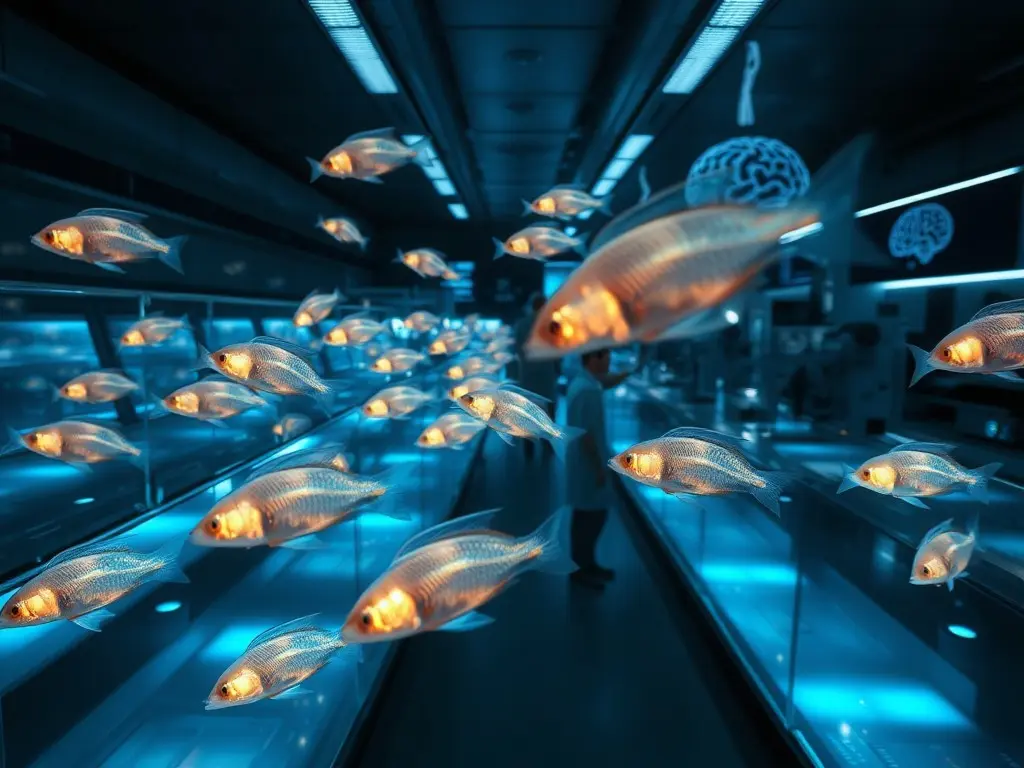
The Howard Hughes Medical Institute's Janelia Research Campus is expanding its focus to study *Danionella cerebrum*, a transparent fish, using AI to decode how brain activity drives complex behaviors like social interaction. The facility plans to triple its fish-dedicated space to 6,000 square feet to accommodate thousands of new tanks and scale research from around 10 to over 100 scientists, aiming to map the fish’s brain connections in real time to better understand brain-behavior links across species." "article": "The Howard Hughes Medical Institute’s Janelia Research Campus near Washington, D.C., is investing heavily in *Danionella cerebrum*, a tiny, transparent fish, to advance brain science. The facility announced plans to triple its fish-dedicated space to 6,000 square feet, expanding research capacity from about 10 to over 100 scientists. *Danionella* lacks part of its skull and has translucent skin, allowing real-time observation of its entire brain—a key advantage over traditional lab models like rodents or zebra fish, which are only transparent in larval stages. The species was officially identified as distinct in 2021, but its transparency makes it ideal for studying neural activity linked to complex behaviors like social interaction. Janelia’s founding executive director, Gerry Rubin, called the bet ‘big and risky,’ but necessary to tackle fundamental questions about how brain processes generate experiences, memory, and decision-making. Unlike prior work on fruit flies, which mapped 54.5 million neuron connections, *Danionella* presents a far greater challenge with three times as many neurons, requiring AI to analyze the massive data output. Janelia aims to develop tools for broader scientific use, including a detailed brain connectome map similar to its 2024 fruit fly project. Nelson Spruston, the campus’s executive director, emphasized that understanding whole-brain function demands observing all neurons firing simultaneously—a task made feasible by *Danionella*’s transparency. The initiative aligns with HHMI President Erin O’Shea’s push to solve the ‘brain-behavior question,’ a core mystery in biology. Researchers like Matt Lovett-Barron of the University of California, San Diego, highlight the fish’s unique advantages, noting its clear head and body are ‘extremely useful’ for neuroscience. Janelia’s expansion signals a shift from insects to vertebrates, leveraging AI to decode neural circuits in a live, behaving organism. The project could redefine how scientists study brain function across species, including humans, given shared evolutionary traits.
The Howard Hughes Medical Institute’s Janelia Research Campus near Washington, D.C., is investing heavily in *Danionella cerebrum*, a tiny, transparent fish, to advance brain science. The facility announced plans to triple its fish-dedicated space to 6,000 square feet, expanding research capacity from about 10 to over 100 scientists. *Danionella* lacks part of its skull and has translucent skin, allowing real-time observation of its entire brain—a key advantage over traditional lab models like rodents or zebra fish, which are only transparent in larval stages. The species was officially identified as distinct in 2021, but its transparency makes it ideal for studying neural activity linked to complex behaviors like social interaction. Janelia’s founding executive director, Gerry Rubin, called the bet ‘big and risky,’ but necessary to tackle fundamental questions about how brain processes generate experiences, memory, and decision-making. Unlike prior work on fruit flies, which mapped 54.5 million neuron connections, *Danionella* presents a far greater challenge with three times as many neurons, requiring AI to analyze the massive data output. Janelia aims to develop tools for broader scientific use, including a detailed brain connectome map similar to its 2024 fruit fly project. Nelson Spruston, the campus’s executive director, emphasized that understanding whole-brain function demands observing all neurons firing simultaneously—a task made feasible by *Danionella*’s transparency. The initiative aligns with HHMI President Erin O’Shea’s push to solve the ‘brain-behavior question,’ a core mystery in biology. Researchers like Matt Lovett-Barron of the University of California, San Diego, highlight the fish’s unique advantages, noting its clear head and body are ‘extremely useful’ for neuroscience. Janelia’s expansion signals a shift from insects to vertebrates, leveraging AI to decode neural circuits in a live, behaving organism. The project could redefine how scientists study brain function across species, including humans, given shared evolutionary traits.
This content was automatically generated and/or translated by AI. It may contain inaccuracies. Please refer to the original sources for verification.