It’s Not Just Nvidia. The A.I. Boom Has Ignited Asia’s Chip Companies.
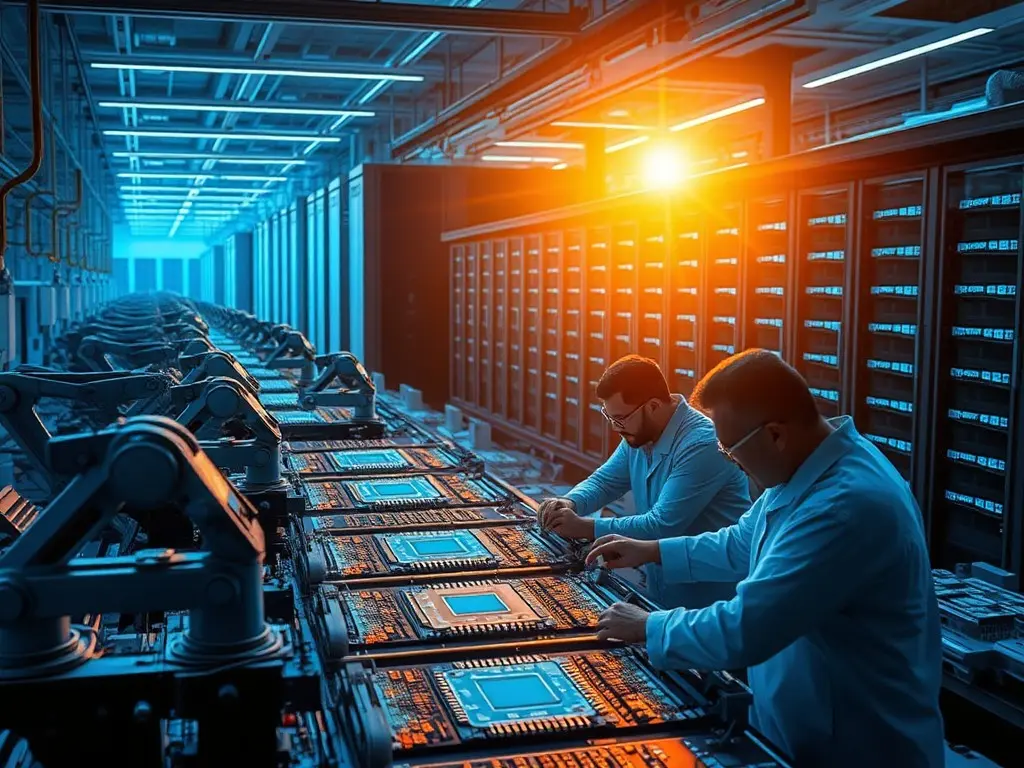
Nvidia CEO Jensen Huang’s visit to Taiwan’s computing show highlighted the surging demand for AI infrastructure, including memory chips from suppliers like SK Hynix, as global tech spending on data centers outpaces supply. Analysts describe the semiconductor industry as now critical global infrastructure, with Asian firms playing a key role in supplying essential but unglamorous components for AI systems worldwide.
Nvidia CEO Jensen Huang drew crowds at Taiwan’s largest computing show this month, where he signed autographs and posed for photos. At SK Hynix’s booth, a major South Korean supplier, he wrote a playful request—‘Please make more :)’—on a memory wafer, a critical but scarce component for Nvidia’s AI supercomputers. The surge in demand for AI-driven data centers has created a global supply crunch, with tech giants investing hundreds of billions of dollars in infrastructure that relies on chips, memory, and power systems. The AI boom has elevated Nvidia to the world’s most valuable publicly traded company, but it has also boosted lesser-known semiconductor firms, particularly in Asia. Companies like SK Hynix, which produce memory chips for storing AI model data, are now central to the industry’s expansion. Analyst Timothy Arcuri of UBS called the sector ‘the most critical infrastructure for the world,’ comparing it to laying down tracks for future commerce. AI systems require both processing chips (like Nvidia’s GPUs) and memory chips to handle vast datasets. As models grow larger, memory technology has become as valuable as processing power. The imbalance between demand and supply is pushing these foundational components into the spotlight, reshaping global tech dynamics. While Nvidia dominates headlines, Asian firms are quietly securing their role as essential partners. SK Hynix’s memory chips, for example, are in high demand for data centers worldwide, underscoring how the AI revolution depends on a supply chain far beyond high-profile chipmakers. The shift is accelerating as companies race to build infrastructure capable of supporting next-generation AI applications.
This content was automatically generated and/or translated by AI. It may contain inaccuracies. Please refer to the original sources for verification.