Jupiter’s Largest Moon Has a Rare Magnetic Field. A Strange Theory May Explain It
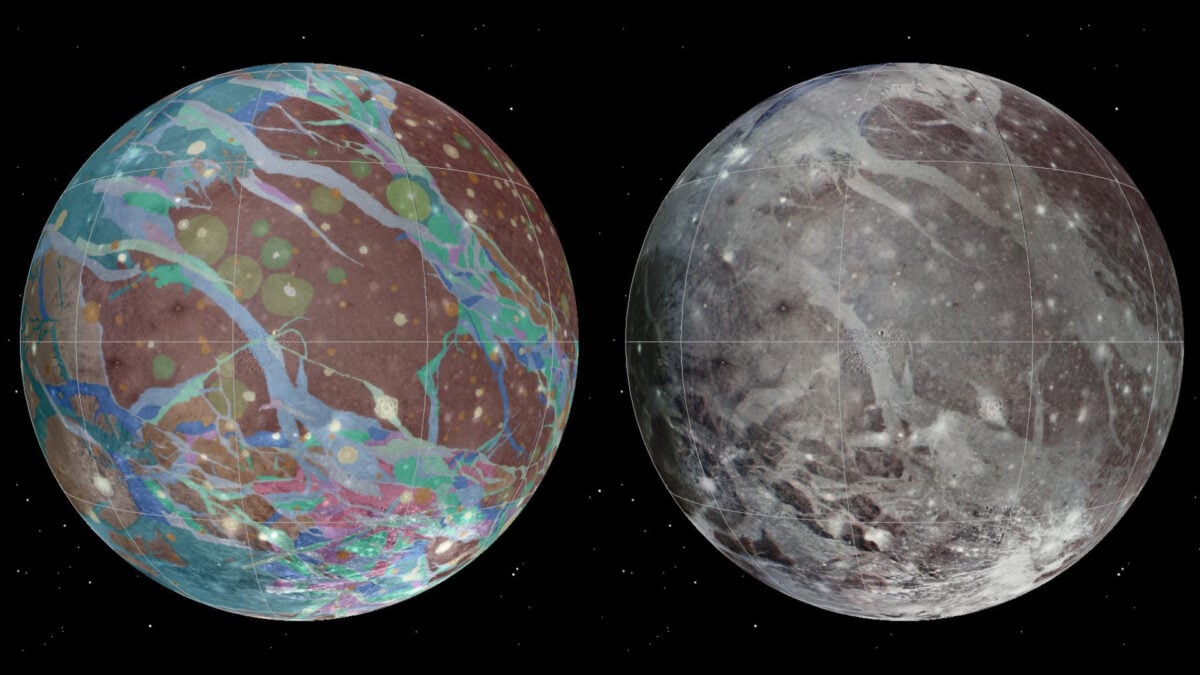
A study published in *Science Advances* proposes Ganymede’s magnetic field is generated by its metallic core still forming today, contradicting the long-held belief that its core solidified 4.5 billion years ago. Researchers at Caltech and Arizona State University used simulations to suggest a 'cold start' formation model, where a migrating liquid iron core powers the moon’s dynamo instead of a cooling, static core.
Ganymede, Jupiter’s largest moon and the only known moon with its own magnetic field, may still be forming its metallic core today, according to new research published in *Science Advances*. The study challenges the prevailing theory that Ganymede’s core solidified around 4.5 billion years ago, alongside the moon’s formation. Instead, lead author Kevin Trinh, a planetary scientist at the California Institute of Technology (Caltech), and his team propose that the moon’s dynamo—its magnetic field generator—is driven by a still-active, migrating liquid iron core. The findings stem from simulations modeling Ganymede’s evolution under a 'cold start' scenario, where the moon began too cold to initially form a molten metal core. Previous dynamo models assumed Ganymede’s core formed early, like Earth’s, but this contradicts formation studies suggesting a cold initial state. Trinh, who conducted the work as a PhD student at Arizona State University (ASU), noted that Callisto, a similarly sized moon, lacks a dynamo, raising questions about why Ganymede differs. The simulations revealed a new mechanism: as Ganymede’s core slowly heats and migrates downward, it stirs the dynamo, sustaining the magnetic field. This aligns with Ganymede’s icy composition and the presence of a subsurface ocean, which NASA’s Juno mission has investigated. The study does not dismiss conventional models entirely but introduces an alternative explanation for the moon’s unique magnetosphere, first detected by the Galileo spacecraft in 1996. Unlike Europa or Enceladus, Ganymede’s magnetic field creates its own magnetosphere, shielding parts of its surface from Jupiter’s radiation. The research suggests this field could persist as long as the core remains partially liquid and dynamic. While direct verification is impossible, the simulations provide a plausible framework for Ganymede’s ongoing geological activity, offering insights into the evolution of icy moons beyond our solar system.
This content was automatically generated and/or translated by AI. It may contain inaccuracies. Please refer to the original sources for verification.