Massachusetts startup launches ‘largest robot data factory in the US’
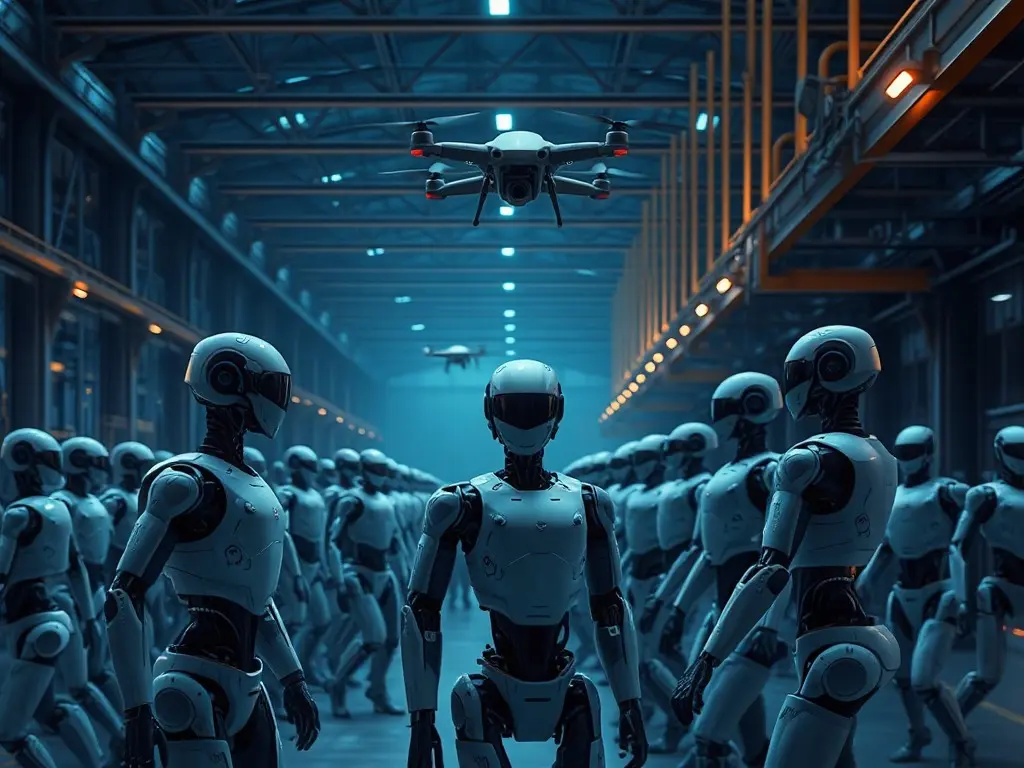
Tutor Intelligence, a Massachusetts-based startup, has launched a 100-robot data factory in Watertown to train AI-powered robots named Sonny for industrial tasks, using vision-language-action models and human supervision. The company, backed by $42 million in funding, aims to make robotics cost-effective for warehouse applications by leveraging cameras and scalable software over expensive sensors and actuators.
A Massachusetts startup, Tutor Intelligence, has activated its 100-robot data factory in Watertown, where machines named Sonny are learning to manipulate objects like hand lotion bottles and snack packages. Each robot is equipped with four cameras and stationary claws, monitored by employees and remote workers in the U.S., Mexico, and the Philippines to refine their performance. The facility, called Data Factory 1 (DF1), is the largest of its kind in the U.S., using Tutor’s vision-language-action model, Ti0, to train robots autonomously. Founded in 2021 by CEO Josh Gruenstein and CTO Alon Kosowsky-Sachs, Tutor emerged from MIT’s Computer Science and Artificial Intelligence Laboratory. The company has raised $42 million, including a $34 million Series A round in December, to scale its AI-powered robot workforce. Unlike competitors relying on expensive sensors or actuators, Tutor uses cost-effective cameras and software, inspired by iPhone production economies of scale. Tutor’s approach prioritizes affordability to ensure competitive ROI for businesses, addressing a key challenge in robotics adoption. The startup’s headquarters occupies a historic Watertown site, formerly a cotton mill and later Boston Scientific’s office. Gruenstein stated the robots will require months of development before industrial deployment, with potential applications in Fortune 500 operations. The company’s model combines large-scale human supervision with autonomous learning to refine robotic tasks. Remote teams globally assist in correcting errors, while on-site employees verify performance. Tutor’s vision-language-action model, Ti0, powers the robots’ ability to handle diverse objects, marking a step toward scalable, factory-ready AI. Kosowsky-Sachs emphasized cost efficiency as critical to commercial viability, noting that expensive hardware could threaten profitability. The startup’s focus on cameras and software aligns with long-term scalability goals. With DF1 operational, Tutor aims to bridge the gap between research and real-world industrial use, positioning itself as a leader in AI-driven robotics.
This content was automatically generated and/or translated by AI. It may contain inaccuracies. Please refer to the original sources for verification.