New rocket-firing drone successfully tested at Fort Rucker
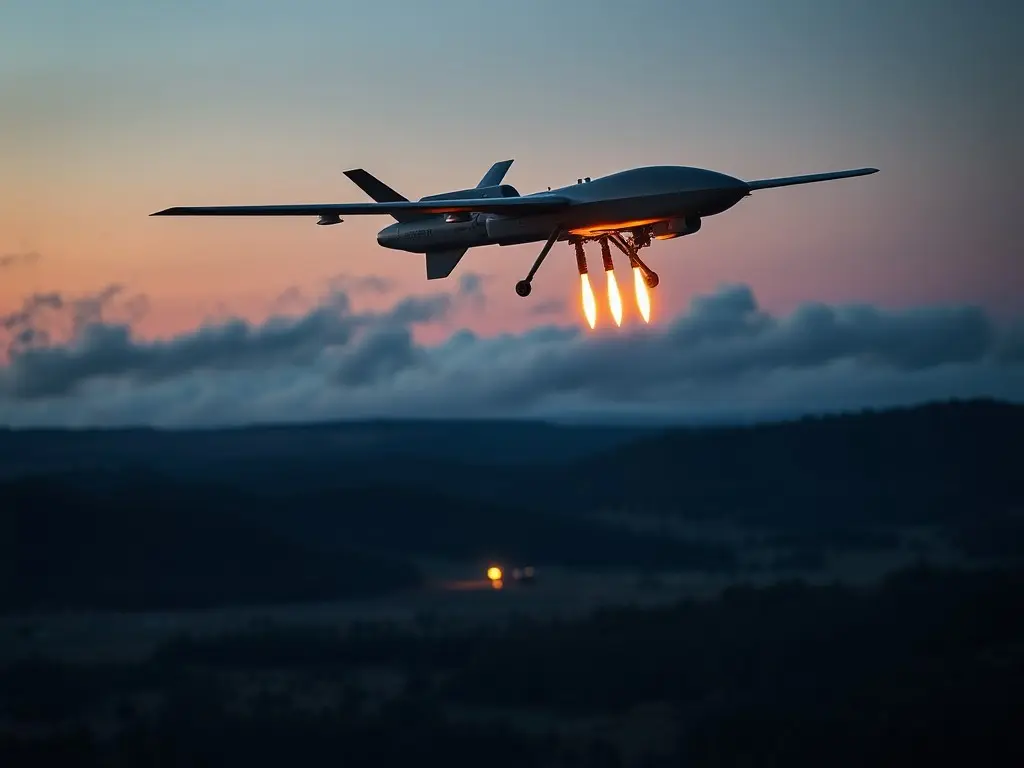
The U.S. Army tested a rocket-firing drone system at Fort Rucker, Alabama, on May 20, 2026, pairing a TRV-150 resupply drone with a three-pack Advanced Precision Kill Weapon System (APKWS) to provide precision strike capabilities to smaller units. The drone, described as a modular 'pickup truck of the sky,' successfully fired 70 mm rockets while maintaining flight stability, demonstrating autonomous navigation and encrypted communications through the Android Tactical Assault Kit (ATAK).
The U.S. Army successfully tested a rocket-firing drone system at Fort Rucker, Alabama, on May 20, 2026. The test involved integrating a three-pack Advanced Precision Kill Weapon System (APKWS), developed by BAE Systems FalconWorks, onto a TRV-150 resupply drone created by Survice Engineering Company. The system uses 70 mm rockets and is designed to provide smaller military units with precision-guided firepower typically reserved for larger aviation units. Testing focused on evaluating the drone’s flight stability and software compensation during rocket launches from a horizontally mounted launcher. The TRV-150, already fielded as a logistics platform capable of carrying up to 150 pounds, demonstrated autonomous navigation and encrypted communications via the Android Tactical Assault Kit (ATAK). Soldiers can input grid coordinates, and the drone calculates routes, range, and payload delivery autonomously. The project was industry-led, with Survice Engineering self-funding development to meet emerging military needs without waiting for government requirements. Clark Dutterer, vice president of business development at Survice Engineering, emphasized the initiative’s proactive approach, calling it a response to evolving battlefield demands. The drone’s modular design allows it to carry various payloads, earning it the nickname 'pickup truck of the sky.' Collaboration involved multiple military organizations, including the U.S. Army Aviation Center of Excellence, DEVCOM Armaments Center, and Program Executive Office for Aviation. The test marked a significant step in expanding precision strike capabilities to frontline battalions, potentially reshaping tactical operations for smaller units.
This content was automatically generated and/or translated by AI. It may contain inaccuracies. Please refer to the original sources for verification.