Pollution from aircraft
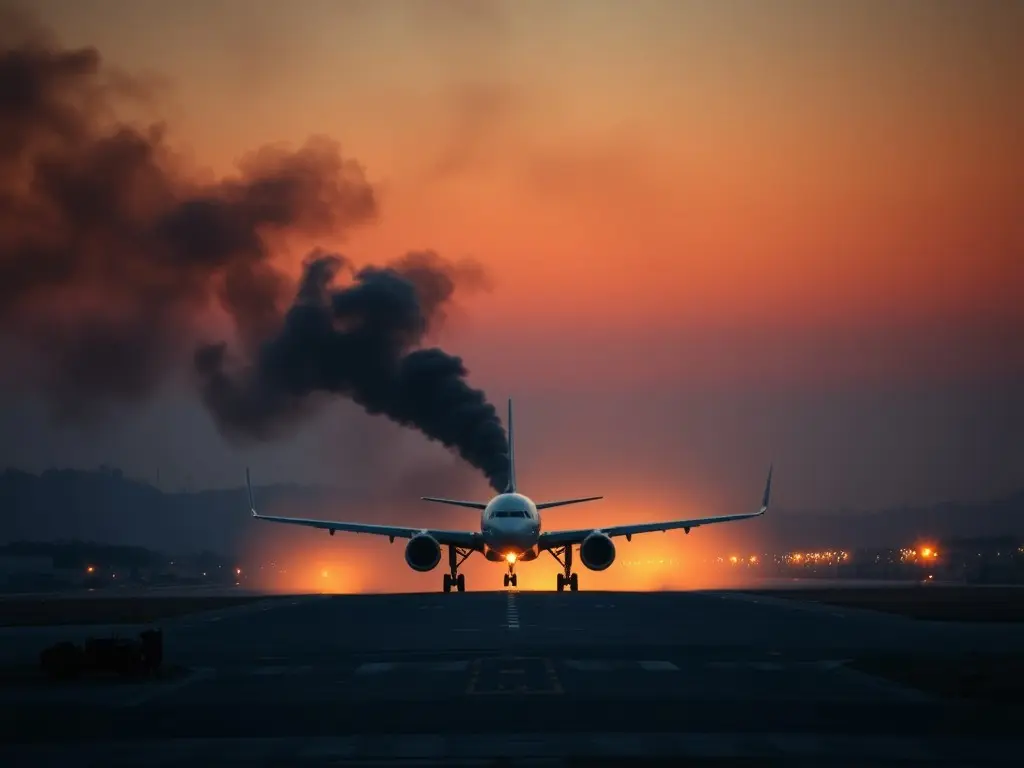
Researchers from the Paul Scherrer Institute (PSI) detected high levels of ultrafine aerosol particles, including lubricating oil, near Zurich Airport during takeoffs and landings, with concentrations up to 300,000 particles per cubic centimeter. The study suggests low-sulphur fuels could mitigate emissions, which pose health risks due to the particles' ability to penetrate deep into the lungs." "article": "Researchers at the Paul Scherrer Institute (PSI) measured ultrafine aerosol particles near Zurich Airport in 2022 and 2024, capturing data in real time near runway 28, the busiest runway. Their spectrometers revealed concentrations of up to 300,000 ultrafine particles (UFPs) per cubic centimeter during takeoffs and landings—over ten times higher than nighttime background levels. These particles, smaller than 100 nanometers, consist of soot and volatile sulphate compounds from fuel combustion, posing health risks as they can penetrate deep into the lungs. The study also identified lubricating oil on the particles for the first time in real-time measurements, confirming earlier findings from Frankfurt and Amsterdam airports. Every aircraft passing overhead at 80–100 meters caused a sharp spike in UFP levels, as downdrafts from wings directed exhaust gases downward. Peaks were more pronounced during landings than takeoffs, and concentrations dropped above 300 meters due to dispersion. While urban areas have higher levels of coarser particulate matter from traffic and industry, Zurich Airport’s UFP levels exceed typical city values. PSI researcher Sarah Tinorua noted that though particle mass is lower at the airport, the sheer number of UFPs is concerning for airport workers and nearby residents. The study suggests switching to low-sulphur fuels could reduce emissions, though further research is needed to assess long-term health impacts. The real-time measurement method allowed precise tracking of particle sources, unlike previous studies that relied on delayed daily averages. Researchers observed that wind patterns influenced dispersion, with particles dispersing rapidly above 300 meters. The findings highlight the need for targeted pollution controls near airports to protect public health.
Researchers at the Paul Scherrer Institute (PSI) measured ultrafine aerosol particles near Zurich Airport in 2022 and 2024, capturing data in real time near runway 28, the busiest runway. Their spectrometers revealed concentrations of up to 300,000 ultrafine particles (UFPs) per cubic centimeter during takeoffs and landings—over ten times higher than nighttime background levels. These particles, smaller than 100 nanometers, consist of soot and volatile sulphate compounds from fuel combustion, posing health risks as they can penetrate deep into the lungs. The study also identified lubricating oil on the particles for the first time in real-time measurements, confirming earlier findings from Frankfurt and Amsterdam airports. Every aircraft passing overhead at 80–100 meters caused a sharp spike in UFP levels, as downdrafts from wings directed exhaust gases downward. Peaks were more pronounced during landings than takeoffs, and concentrations dropped above 300 meters due to dispersion. While urban areas have higher levels of coarser particulate matter from traffic and industry, Zurich Airport’s UFP levels exceed typical city values. PSI researcher Sarah Tinorua noted that though particle mass is lower at the airport, the sheer number of UFPs is concerning for airport workers and nearby residents. The study suggests switching to low-sulphur fuels could reduce emissions, though further research is needed to assess long-term health impacts. The real-time measurement method allowed precise tracking of particle sources, unlike previous studies that relied on delayed daily averages. Researchers observed that wind patterns influenced dispersion, with particles dispersing rapidly above 300 meters. The findings highlight the need for targeted pollution controls near airports to protect public health.
This content was automatically generated and/or translated by AI. It may contain inaccuracies. Please refer to the original sources for verification.