School cafeteria workers demand action on staffing shortages, working conditions
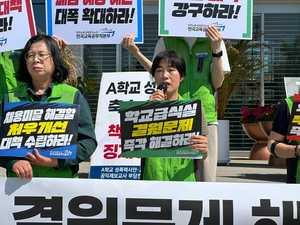
Unionized school cafeteria workers in South Korea demanded urgent action to address a nationwide staffing shortage of 1,852 workers last year, citing unsafe workloads and poor working conditions. A study found each worker handles meals for 114.5 students on average, nearly double the public institution average, while budget cuts for ventilation improvements worsen risks of industrial accidents.
Unionized school cafeteria workers in South Korea held a press conference outside the Seoul Metropolitan Office of Education on Wednesday, calling for immediate action to resolve severe staffing shortages and improve working conditions. The National Union of Education Public Service Workers reported that school kitchens across 17 cities and provinces were short by 1,852 workers last year, with an additional 3,118 unfilled positions in 14 cities and provinces, resulting in a 27% shortfall rate. Workers described extreme conditions, including handling heavy equipment without adequate staffing. Myung Jae-eun, a union member and school cook, stated that one worker now performs the duties of two, leading to physical strain and unsafe working environments. The union highlighted that understaffing creates a 'vicious structural cycle,' increasing workloads and driving existing workers to quit. A study by Incheon National University found that school cafeteria workers prepare meals for an average of 114.5 students, nearly double the 65.9 average for cooks at other public institutions. The union argued that workloads must be reduced by increasing staffing levels by 23% to ensure safety. They also criticized budget cuts for ventilation improvements, noting that 54 of 301 inspected school cafeterias had inadequate systems, while the 2026 budget for repairs in 16 cities and provinces dropped by 70.98 billion won from last year’s allocation. The union leader, Jeong In-young, emphasized the need for standardized meal-to-worker ratios to break the cycle of understaffing. The group stressed that current conditions force workers to endure back pain, wrist numbness, and high risks of industrial accidents without adequate support or relief.
This content was automatically generated and/or translated by AI. It may contain inaccuracies. Please refer to the original sources for verification.