Scientists Find Cosmic 'Rosetta Stone' To Decode Baffling Signals From Deep Space
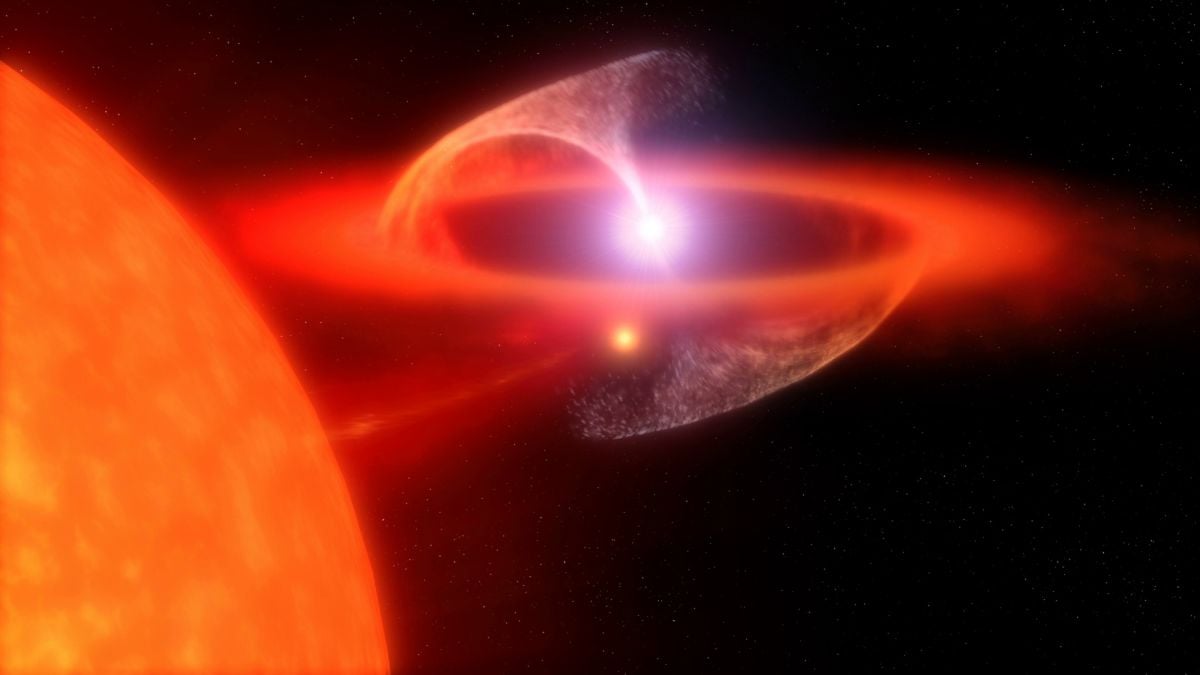
A team led by astronomer Kovi Rose of the University of Sydney identified a magnetic cataclysmic variable star as the source of a mysterious long-period radio transient (LPT) signal, linking it to a white dwarf cannibalizing its companion star. This discovery unites multiple observed LPT characteristics, including radio and X-ray emissions, orbital motion, and accretion processes, offering a potential 'Rosetta Stone' for understanding these baffling cosmic signals detected across the Milky Way.
Astronomers have traced a strange, pulsing radio signal from deep space to a magnetic cataclysmic variable star in the Milky Way’s inner regions. The signal, one of around a dozen detected long-period radio transients (LPTs), originates from a white dwarf star actively pulling material from a companion star, a process known as accretion. The discovery, led by Kovi Rose of the University of Sydney, marks the first time researchers have observed both stars and the accretion process in action within an LPT source. The signal, named ASKAP J1745-5051, pulses every 18.18 minutes for 30 to 60 seconds, temporarily becoming one of the brightest objects in the low-frequency radio sky. This object unifies multiple previously observed LPT traits, including radio and X-ray emissions, strong magnetic activity, and orbital motion—features no single object had previously explained. LPTs were first detected in 2022, with signals like GLEAM-X J162759.5−523504.3 and ILT J1101+5521 later traced to binary star systems involving white dwarfs. However, ASKAP J1745-5051 stands out due to its combined emissions and clear evidence of accretion, offering a cohesive explanation for these mysterious cosmic pulses. Astrophysicist Tara Murphy of the University of Sydney and OzGrav called the discovery a 'Rosetta Stone' for interpreting LPTs. The findings suggest that some of these signals may arise from magnetic white dwarfs in binary systems, where gravitational interactions trigger periodic radiation bursts. This breakthrough follows earlier observations of objects like ASKAP J1832-0911, which emitted both radio and X-rays, hinting at complex energetic processes. The new discovery consolidates these clues into a single, well-understood cosmic phenomenon, potentially resolving years of astronomical puzzlement.
This content was automatically generated and/or translated by AI. It may contain inaccuracies. Please refer to the original sources for verification.