SpaceX launches Falcon Heavy for ViaSat-3 mission
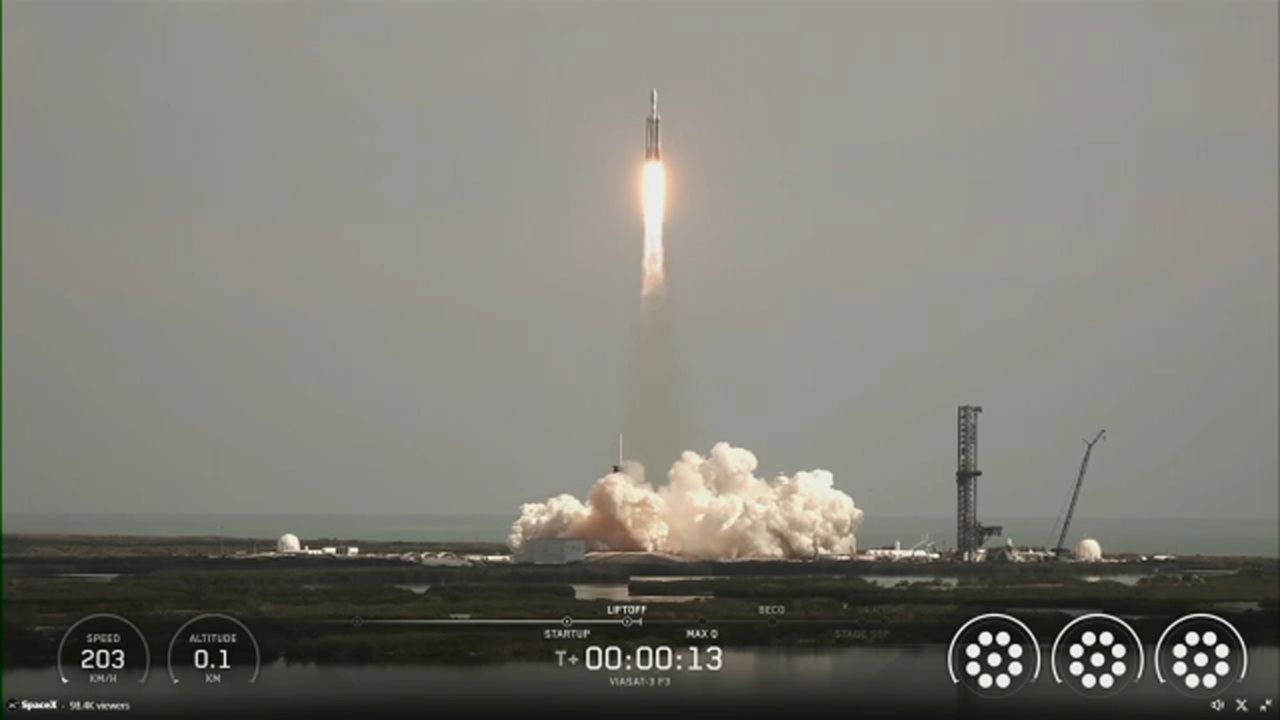
SpaceX successfully launched its Falcon Heavy rocket from Kennedy Space Center on April 27, 2026, deploying ViaSat’s ViaSat-3 F3 telecommunications satellite toward geostationary orbit. The mission followed a scrubbed Monday attempt due to unfavorable weather, with the rocket’s side boosters landing while the center booster was not recovered.
SpaceX launched its Falcon Heavy rocket from Kennedy Space Center’s Launch Complex 39A on April 27, 2026, at 10:13 a.m. ET, successfully deploying ViaSat’s ViaSat-3 F3 satellite. The mission marked the first Falcon Heavy launch since NASA’s Europa Clipper mission in October 2024. The rocket consists of three Falcon 9 boosters, totaling 27 Merlin engines, with side boosters B1072 and B1075 landing at Landing Zones 40 and 2, respectively. The center booster, B1098, was not recovered after its maiden flight. The launch followed a scrubbed attempt on April 24 due to strong winds and poor weather conditions, which delayed the mission from its original Tuesday target. The ViaSat-3 F3 satellite, built by California-based ViaSat, will spend months reaching geostationary orbit before entering service by late summer 2026. It will undergo rigorous testing to ensure operational readiness for commercial and defense customers. The Falcon Heavy’s side boosters, B1072 and B1075, had prior missions, including the GOES-U weather satellite launch in June 2024 for B1072. The center booster, B1098, made its only flight during this mission. ViaSat’s satellite is designed to provide advanced broadband communications, enhancing mobility, fixed services, and defense applications. The launch window opened at 10:21 a.m. ET on April 24 but was delayed due to weather concerns, with the 45th Weather Squadron citing cumulus clouds and surface electric fields as risks. The successful liftoff on April 27 confirmed the rocket’s capabilities, despite the challenges faced earlier in the week.
This content was automatically generated and/or translated by AI. It may contain inaccuracies. Please refer to the original sources for verification.