Streetlights Are Trapping Thousands of Isopods in Mysterious “Death Spirals”
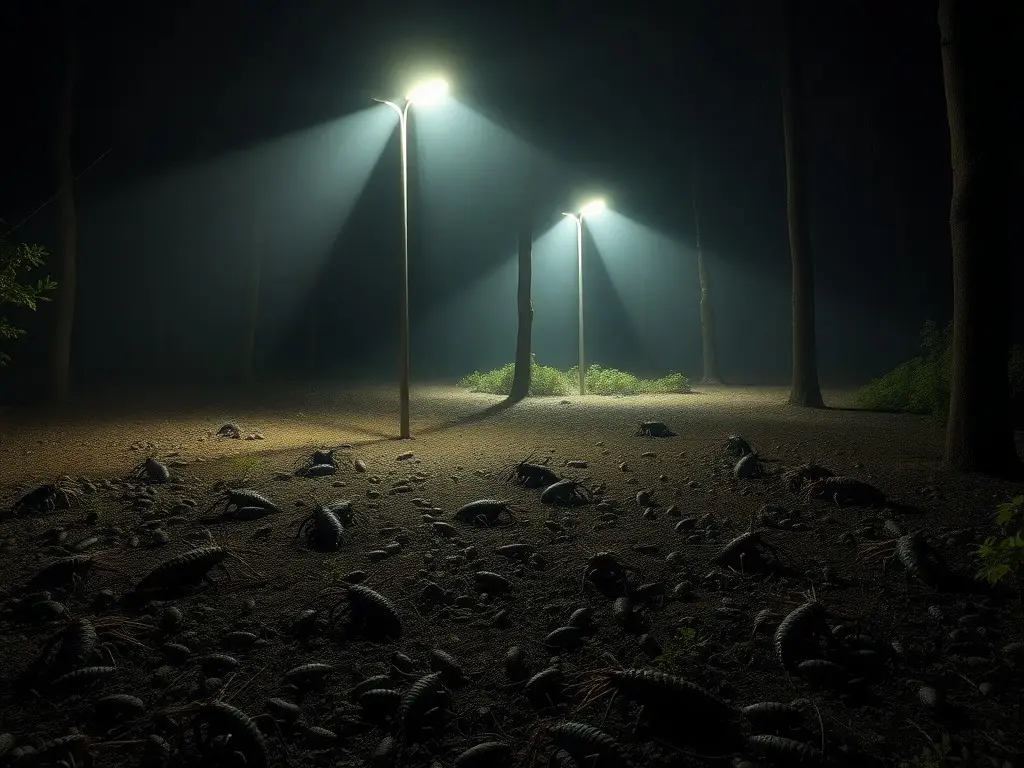
Researchers at The Hebrew University of Jerusalem observed thousands of Israeli isopods (*Armadillo sordidus*) forming synchronized circular "death spirals" near artificial streetlights in the Golan Heights. The study, published in *Ecology and Evolution*, found vertical white light disrupts their natural behavior, potentially exposing them to predators and altering their known range beyond southern Syria and the Golan Heights into the Jezreel Valley.
A team led by PhD student Idan Sheizaf and Prof. Ariel Chipman from The Hebrew University of Jerusalem documented an unprecedented behavior in Israeli isopods (*Armadillo sordidus*), where thousands gather in large circular processions triggered by artificial streetlights. The phenomenon, first noticed by amateur naturalist Eviatar Itzkovich in the Golan Heights, involves isopods—commonly called woodlice or pill bugs—leaving their sheltered habitats to swirl in "mills" containing over 5,000 individuals. The study, published in *Ecology and Evolution*, tested environmental triggers like magnetic fields and ultraviolet light but found only vertical white light reliably induced the circular movement. The light creates a bright boundary on the ground, drawing isopods into a collective swirl that persists once formed. Unlike typical clustering for moisture retention, these processions appear unnatural, with most participants being egg-carrying females, suggesting a disruption of instincts caused by artificial light at night (ALAN). The discovery expands the known range of *A. sordidus*, previously recorded only in southern Syria and the Golan Heights, to include the Jezreel Valley. Researchers warn the behavior may expose isopods to predators, as observed when a centipede preyed on individuals in one instance. The study highlights an unexpected consequence of light pollution for ground-dwelling creatures. Sheizaf noted the phenomenon reflects how modern light geometry—like circular streetlight pools—interacts with natural animal instincts, creating visually striking but potentially harmful emergent behaviors. The findings underscore the broader ecological impact of artificial lighting on nocturnal species.
This content was automatically generated and/or translated by AI. It may contain inaccuracies. Please refer to the original sources for verification.