The lab never sleeps. Can the science keep up?
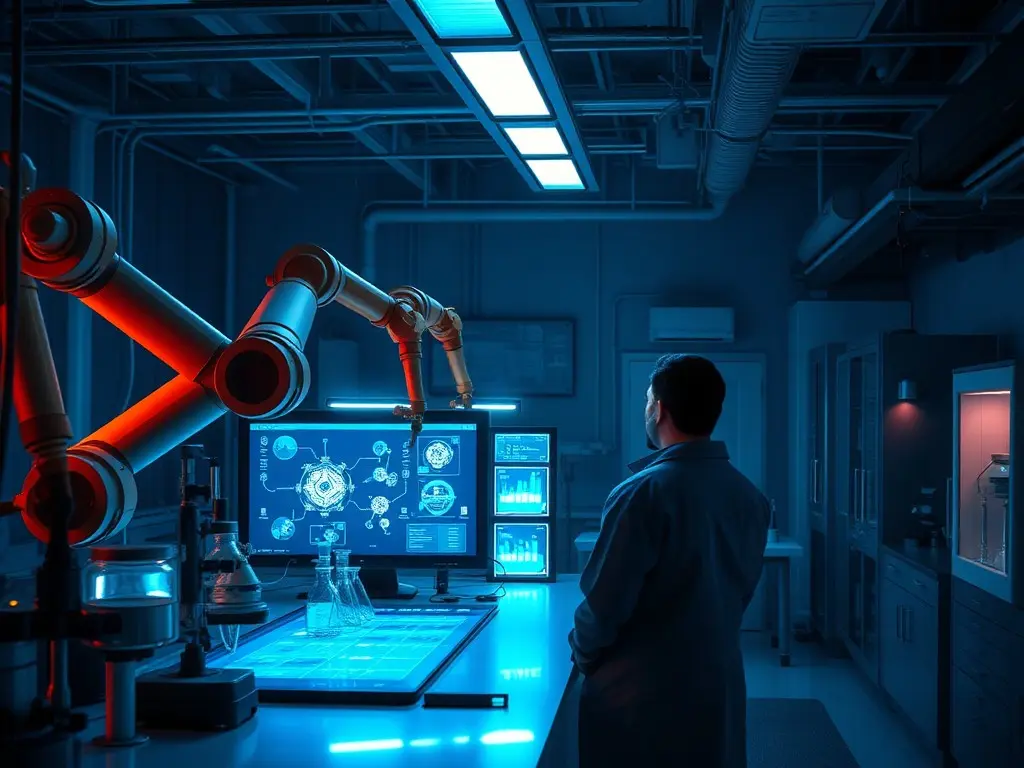
The A-Lab at UC Berkeley and Lawrence Berkeley National Laboratory uses AI-powered robots to autonomously conduct material science experiments overnight, processing samples through synthesis, testing, and analysis. A 2023 Nature paper claiming breakthrough discoveries was later corrected, highlighting the need for human verification despite AI’s speed in accelerating scientific research.
A fully automated laboratory at UC Berkeley’s Hearst Memorial Mining Building, called the A-Lab, operates around the clock using AI-driven robots like Minerva, Alfred, and Prometheus to synthesize and test new materials. The system combines robotic arms, centrifuges, ovens, and X-ray diffraction tools, with graduate students remotely troubleshooting issues via email and Slack alerts. Gerbrand Ceder, the lab’s lead materials scientist, aims not only to discover better materials but also to develop AI capable of acting like a scientist. The A-Lab, a collaboration between UC Berkeley and Lawrence Berkeley National Laboratory (LBNL), integrates robotics, lab automation, and custom AI to create a 'lab in the loop' system. This setup allows the lab to experiment, iterate, and propose next steps independently, leveraging LBNL’s supercomputing resources, including the National Energy Research Scientific Computing Center (NERSC). The lab’s speed—100 times faster than human researchers—has forced early adaptations, such as rigging a fake finger to operate machinery. In 2023, the lab published a high-profile study in Nature claiming the autonomous synthesis of dozens of new materials in days. However, external scrutiny later raised doubts about the novelty of the materials and the validity of the data, leading to a correction. The incident underscored a critical challenge: while AI and robots can accelerate experiments, human oversight remains essential for verifying results and ensuring scientific rigor. Beyond the A-Lab, automated labs are transforming scientific research by generating data at scales unattainable by humans. Machine learning analyzes vast datasets, and AI agents guide experimental decisions, potentially revolutionizing fields like drug development and biotechnology. The race for global leadership in biotech and AI-driven science hinges on balancing speed with accuracy, as faster discoveries may not always equate to better science. The A-Lab’s infrastructure relies heavily on NERSC, which is also developing a new supercomputer named Doudna in honor of UC Berkeley biochemist Jennifer Doudna, a 2020 Nobel Prize winner. This collaboration exemplifies how cutting-edge computing and AI are reshaping scientific workflows, though the field continues to grapple with questions of reliability and human involvement in autonomous research.
This content was automatically generated and/or translated by AI. It may contain inaccuracies. Please refer to the original sources for verification.