We fact-checked the Oklahoma Republican State Superintendent debate
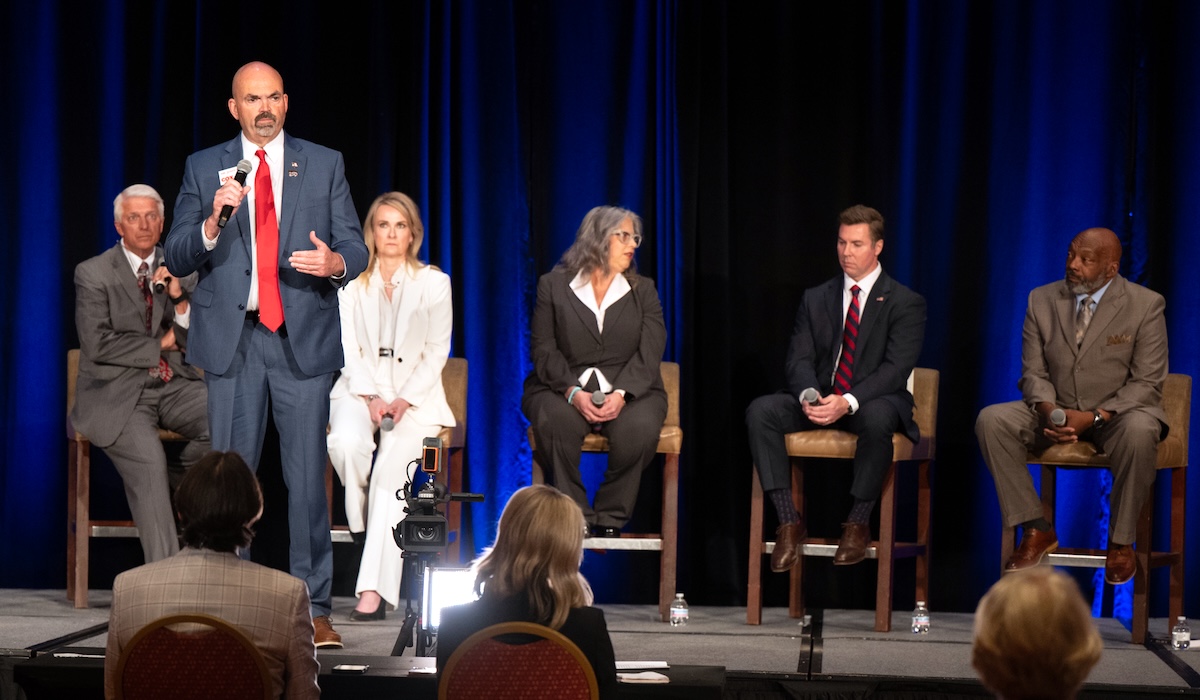
*The Frontier* fact-checked claims made by Republican candidates for Oklahoma State Superintendent during a June 2 debate, verifying statements about stalled school chaplain legislation, past voting records, and a proposed school counselor pipeline. The fact-check found Cox’s claim about stalled chaplain bills was mostly true, while Taylor’s assertion about Pugh and Hasenbeck’s votes was mixed, and Hasenbeck’s claim about a school counselor pipeline was mostly true but lacked legislative filing.
*The Frontier* partnered with NonDoc to fact-check statements made by Republican candidates for Oklahoma State Superintendent during their June 2 debate in Norman. Candidates John Cox, Robert Franklin, Toni Hasenbeck, Debra Herlihy, Adam Pugh, and James Taylor faced scrutiny over specific claims. Cox claimed a bill to place chaplains in schools for mental health support had stalled in the Senate for three years. The fact-check found this was mostly true, as Senate Bill 36 in 2024 included chaplain provisions but was later amended to remove them, focusing instead on law enforcement records. Earlier bills had failed to advance past the Senate education committee, though none explicitly banned proselytizing or set education requirements like SB 36 did. James Taylor accused Pugh and Hasenbeck of voting to ‘put Ryan Walters in a box’ by approving Senate Bill 36X in 2023, which restricted Walters’ authority over federal funding. The claim was mixed—while both voted for the bill, its intent was to allocate $250,000 for school inhalers and require legislative approval before rejecting federal grants. Walters had threatened to reject programs conflicting with ‘Oklahoma values,’ prompting concerns among lawmakers. Hasenbeck claimed she proposed a $68 million school counselor pipeline bill in 2019. The fact-check found this was mostly true—she discussed legislation with staff but did not file it, citing budget concerns. The proposal would have required dedicated counselors per school, with waivers for those pursuing master’s degrees. Hasenbeck argued the cost made it politically unviable, as permanent funding would have locked in the expense. The fact-check relied on interviews, public records, and legislative archives to verify claims. Cox’s chaplain bill assertion was accurate, though the timeline was slightly exaggerated. Taylor’s critique of Pugh and Hasenbeck’s votes was partially correct but oversimplified the bill’s intent. Hasenbeck’s counselor pipeline claim was substantiated but lacked formal legislative action.
This content was automatically generated and/or translated by AI. It may contain inaccuracies. Please refer to the original sources for verification.